


 by
by Scholars often observed how less-dominant languages are being spoken less and less. As a result, the dominant varieties might take over, leading the world toward less multilingual societies and cultural losses. Are non-Mandarin Chinese varieties in Malaysia an analogous trend of monolingualism and cultural loss? When the British colonised Malaysia, they regarded the Malays as unskilled and unable to develop the colonial economy. Chinese and Indian immigrants were considered as labourers. These migrants brought along their community languages so that they were able to communicate and stay close to help one another. What is the current sociolinguistic situation of Malaysian Chinese communities?
Linguistic Overview
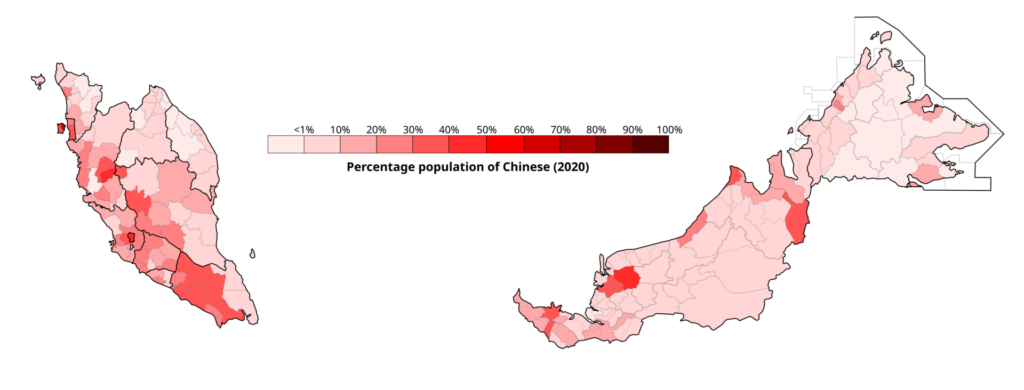
Malaysia is a federation in Southeast Asia composed of 13 states and 3 separately administered federal territories. Such vast territory is characterised by a distinct linguistic landscape, the three major ethnic groups are Malay, Chinese, and Indian. Diverse communities who gained independence from British rule in 1957. On top of that, other minority groups are further observed in everyday life such as Vietnamese, French, German, Nepali, Tagalog, Bahasa Indonesian, Korean, and Japanese. In 2020, Malaysian Chinese are the second-largest ethnic community with approximately 6.91 million members among Malaysian citizens, the so called “ethnic Chinese” or in some specific cases “Tang people” 唐人 tángrén. Identifying themselves as distinctive groups with a historical inheritance of identity, reflecting their own linguistic and cultural varieties, such as the people from the Chinese territories of Fujian, Hakka, Fuzhou, Guangxi, Xinghua, Fuqing and others. Although linguists classify Chinese language varieties as distinct languages, they are often referred to as dialects. Many of these varieties are mutually unintelligible, even among speakers within the same group. The Chinese varieties spoken by Malaysian Chinese communities include several subgroups of Min (i.e., Hokkien, Teochew, Xinghua, Hainan, Foochow), Hakka, and Yue (i.e., Cantonese).
The dominance of Mandarin among Chinese communities in Mainland China, Taiwan, Macao, Hong Kong, Singapore, and other regions has been widely reported and analysed; this article focuses on the case of Malaysia. Although some Chinese schools in various overseas communities still teach dialects. The current mainstream trend in international Chinese inheritance language teaching is to unify the use of Mandarin as the standard, the so called “Common Language” 普通话 pǔtōnghuà. With an increase in Mandarin Chinese literacy resulting from Chinese medium education, formal usage of dialects has decreased over the years and may only be used in rural churches for preaching and reading of religious texts. Chinese primary schools in Malaysia are often funded by Chinese associations and individuals, with support sometimes politically incentivised during elections by Chinese-based parties. Mandarin was introduced as the medium of instruction in the 1920s and is widely used in media, education, and increasingly among younger Malaysian Chinese. There are also newspapers, magazines, dramas, and films on television and in cinemas using Mandarin as the primary medium.
Historical and Social Frameworks
Under British rule, schools for locals and migrant children were divided according to the languages of instruction. As a result, the colonial government did little to promote national integration or foster a shared identity, and migrant communities largely remained in separate enclaves without a strong sense of belonging to the nation. The history of the racial conflicts in Malaysia began with the Chinese migrations in the 19th century and was exacerbated in 1957 after the independence from the United Kingdom. The colonial rule and the Japanese occupation let to a communist insurgency with fragile race relations. The selection of Malay, the language of the majority, as the national and official language, along with special privileges granted under the Malaysian Constitution (e.g., customary land rights) was perceived as racially biased. Consequently, the majoritarian party, United Malays National Organisation (i.e., UMNO), significantly lost parliamentary seats. While it still held a majority in Parliament, the Chinese-based opposition party claimed “victory”. As a result, the tensions between Malays and Chinese communities culminated in the 1969 racial riots. In response, Malaysian policymakers promoted Bahasa Malaysia as the national language and developed a national education system to foster cultural unity and to support the nation’s social and political development. During the 1970s and 1980s, this approach came to be known as the ‘One Language One Culture’ policy, because it promoted a single, unified national culture.
Social tensions declined in the 1990s with government support for the teaching of standardised ethnic languages as a school subject. Standardised ethnic languages, namely Mandarin for the Chinese and Tamil for the Indian, serve as the medium of instruction. The dominant socio-political influences decide the family language for communication rather than parents/grandparents. Likewise, studies have also shown that many Malay children are not speaking Malay community languages, while Indian children are not learning Telugu, Gujarati, Punjabi and Malayalam. Children who attend Chinese or Tamil medium primary schools often acquire an additional language, Mandarin or Tamil. However, Tamil medium private schools are largely absent, as the Tamil community often cannot afford this option. Consequently, many families choose not to pass on the ethnic language to children, prioritising standard languages instead.
As reported by several analysts and scholars, racial discrimination in Malaysia remains far from being resolved. Racism pervades multiple aspects of contemporary Malaysian society, including employment-related discrimination, education, economic policies, housing, and language policies. Systemic exclusion from meaningful employment opportunities contributes to income inequality, social marginalisation, and intergenerational disadvantage, in breach of the Universal Declaration of Human Rights and key International Labour Organisation conventions. Research indicates that students who experience racial bias are likely to undergo trauma, leading to decreased confidence and motivation, eroding academic performance, and negatively affecting long-term social and economic mobility. Moreover, racism in the housing sector is characterised by a combination of prejudice and structural weaknesses in state and federal regulation and policy. Regarding language policy, discriminatory practices have been observed affecting Chinese minorities and non-Malay-speaking individuals within Malay communities. However, it is important to highlight that multilinguism in Malaysia is allowed and incentivised. Article 152 of the Federal Constitution states, “While Malay is the national language, the freedom to learn, use and develop the mother tongue of all communities is expressly guaranteed”. Additionally, documents such as UNESCO Universal Declaration on Cultural Diversity (2001) affirm the importance of cultural plurality and recognise that “All persons have therefore the right to express themselves and to create and disseminate their work in the language of their choice, and particularly in their mother tongue” (i.e., Article 5). Conversely, it has been reported how Standard Chinese is gradually taking on this role, even replacing Chinese dialects within the domestic domain.
New Generations VS Old Generation?
To determine the active use of a language, linguists analyse several sociolinguistic factors, one of the most significant being usage among young people, who can ensure the preservation of both the language and the corresponding culture. Several factors contribute to the ongoing language shift among Chinese Malaysians. A significant number of Chinese Malaysian parents send children to Chinese-medium primary schools, where Mandarin serves as the medium of instruction. However, few studies have examined how the younger generation perceives the importance of the relation between dialects and cultural heritage. At the same time, the dominance of major languages in most social and professional domains has reduced opportunities to use community languages. In the broader context, speaking Mandarin is advantageous because it allows individuals to claim membership within the Chinese community worldwide. In the past, membership in Chinese dialect groups in Malaysia was essential for survival and for business networks. Giving speakers access to cultural ideals, norms, and ways of thinking that collectively contribute to the community. However, heritage languages now have low instrumental value, compared to Mandarin. Therefore, younger generations increasingly perceive Mandarin as conveying higher social prestige due to wider versatility of the language. On another note, research suggests that younger Chinese Malaysians tend to feel more positively toward Malaysian Mandarin Chinese than toward the variety spoken in Mainland China. Indicating that the language and cultural preferences of young Malaysians may reflect a strong sense of local cultural identity rather than external influence.
Studies on older generations bring peculiar results. Not only are new generations giving up on community languages, but also parents and grandparents seem to be slowly shifting toward Mandarin. The findings indicate that participants used Chinese heritage languages in everyday lives, particularly in domestic domains, employment, religion, and friendship. However, there is a noticeable shift toward Mandarin, which is increasingly perceived and used as the primary medium of communication in analogous circumstances. Analysis of the interviews suggests that the main functional distinctions between these languages remain in communication with friends and with family members or peers of the same or older generations. Not only do middle-aged and older speakers rely on Mandarin when interacting with younger generations who cannot understand or speak Chinese heritage languages, but also with individuals from other Malaysian states who may not share the same heritage languages. This language shift is not driven by personal preference for Mandarin among middle-aged and older speakers. Rather, it reflects a pragmatic need to accommodate younger generations and others who do not speak Chinese heritage languages. Moreover, recent studies also investigated the reasons that led parents to shift to Mandarin. Exposure of children to the heritage language through having grandparents as carers and media was not effective for language maintenance. Some parents also believed that transmitting heritage languages was not considered useful. In other circumstances, children are responsible for ‘micro-language decisions’ at the family level. The choice of Mandarin and English was affirmed by the broader sociopolitical context, whereby proficiency in standard languages ensures access to educational and career opportunities.
Conclusion
It seems inevitable that Chinese heritage languages in Malaysia are going to vanish. However, these studies report that Mandarin, particularly the Malaysian variety, plays a fundamental role in Malaysian Chinese communities as a primary language in community events, everyday life, media, and the domestic domain. Is Malaysian Mandarin Chinese then a modern tool to build a sense of a common cultural identity that strengthens local culture rather than an obstacle to heritage preservation?
Francesco Biancalana is a Master student at University of Naples, Italy, and a DDRN intern


Only a limited number of schools incorporate the use of Chinese dialects, and not all schools in Malaysia offer heritage language education, particularly those outside National-Type Chinese Schools, where Mandarin is the main medium. This results in noticeable differences in parental expectations and teaching standards. As noted by Qian (2024:60), “Malay teachers and classmates dominate public schools, while Chinese teachers and classmates dominate private schools. Parents of the two types of schools have different expectations for their children’s future, with children in public schools having more chances of staying in Malaysia to further their education. In contrast, private school students are more likely to go abroad for further studies after high school.” Moreover, access to heritage languages education is uneven across communities. As highlighted in the article, “Tamil medium private schools are largely absent, as the Tamil community often cannot afford this option.” This aligns with Ting (2009:11.8), who reported that “that privately-supported Tamil schools do not exist since the Tamil community cannot afford this luxury.”


Mandarin has become increasingly important in the economic sphere. In contrast to the past “Chinese dialect groups in Malaysia was essential for survival and for business networks” (Ong, 2023:33), Mandarin is now widely used within Chinese communities
for business purposes, making it a valuable asset in the job market.