by
by At a plantation in coastal Ecuador, a crate of bananas is set aside, not because it is spoiled, but because it is slightly curved in the wrong way, too small, or marked by minor blemishes. Thousands of kilometers away, in a Paris supermarket, sealed yogurt containers are emptied into a bin at the end of the day, discarded not for contamination, but because they have passed their “best before” date. Neither is unsafe. Yet both are destined for waste.
This contrast is not incidental. It reflects a deeper structural reality within the global food system, where food is routinely discarded both before and after it reaches the market. According to the Food and Agriculture Organization, roughly one-third of all food produced globally is lost or wasted, while the European Commission reports over 58 million tonnes discarded annually in Europe alone.
What emerges is not a broken system, but a coordinated one: production and retail practices that generate surplus on one end and enforce selectivity on the other. The result is a continuous flow of food that is grown, transported, and ultimately discarded at different stages of the same supply chain. To understand how this dynamic takes shape, it is necessary to begin at the source: the conditions under which food is grown, selected, and often discarded long before it ever reaches global markets.
The Producer’s Burden: Invisible Waste in Peru
In export-oriented regions such as Latin America, food waste is not primarily the result of poor farming practices or environmental conditions. It is shaped by the requirements of international trade.
Global supply chains operate under strict grading systems in which the value of produce is determined by standardized criteria of size, color, and shape. Retailers in high-income markets impose detailed specifications that define what is considered marketable. Produce that deviates from these parameters, even slightly, is excluded from export channels regardless of its nutritional quality. This system effectively prioritizes visual uniformity over edibility.
For producers these requirements create a structural dilemma. Because even minor imperfections can lead to rejection, farmers are compelled to overproduce as a form of risk management. To fulfill a contract for a fixed quantity of “Class A” produce, growers must account for the proportion of their harvest that will not meet these standards.
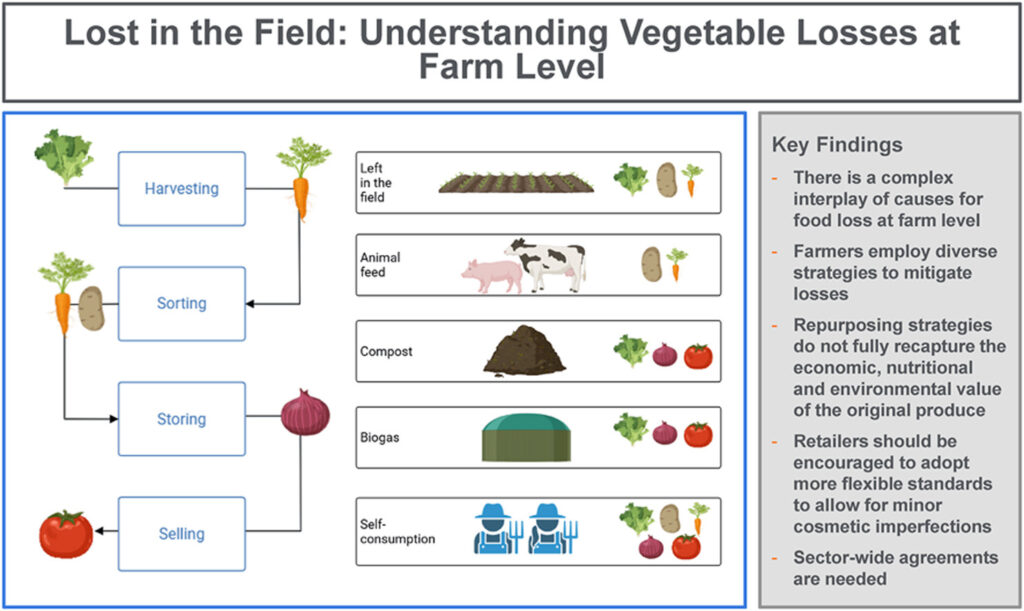
Evidence from Peru illustrates the scale of this dynamic. A case study from the REFRESH Project documents how cosmetic specifications imposed by export markets generate substantial losses at the farm level. In some crops, rejection rates range from 10 to 40 percent depending on quality requirements. In one instance, more than 3,500 tons of edible onions were discarded in a single year because they did not meet size or shape criteria. Citrus producers face even higher levels of uncertainty, with exportability rates for certain fruits dropping to around 50 percent. When local markets are unable to absorb this surplus, rejected produce is often left to decompose or is buried, as the cost of transport exceeds its potential value.
Price volatility further intensifies these losses. Agricultural markets are highly sensitive to fluctuations in supply and demand. Periods of overproduction can lead to sharp declines in prices, making it economically unviable to harvest or distribute crops. In such conditions, farmers may leave produce in the fields, not because it lacks demand in absolute terms, but because it cannot be sold at a price that covers production and distribution costs. This reflects a broader imbalance in which producers bear the risks of market instability while operating within constraints set by distant buyers.
The environmental implications of this upstream waste are significant. Food that is never consumed still embodies the full cost of its production. Water, fertilizers, land, and labor are expended regardless of whether the crop reaches the market. According to the Food and Agriculture Organization, agriculture accounts for a substantial share of global freshwater use, meaning that production losses translate directly into resource waste.
This is particularly evident in regions such as the Ica Valley in Peru, where large volumes of water are used to produce export crops that may ultimately be discarded due to market standards. Studies highlight that water-intensive food is wasted in areas already facing severe water stress, illustrating how food loss translates directly into inefficient use of scarce water resources.
The result is a system in which a significant share of food is filtered out at the very beginning of the supply chain. This upstream waste remains largely invisible to consumers, yet it forms a foundational part of the global food economy and sets the stage for further losses at the retail level.
The Retail Gatekeeper: Why Good Food Dies on the Shelf
While part of the global food waste crisis occurs on distant farms, it also continues in the climate-controlled aisles of supermarkets. In these regions, food waste is not caused by a lack of technology or storage capacity. Rather, it is the result of retail strategies that prioritize brand image, visually appealing displays, and risk avoidance over the actual consumption of food. Supermarkets function as the ultimate gatekeepers of the supply chain, and internal policies often mandate the disposal of large quantities of perfectly edible products.
One of the most significant drivers of this waste is the “aesthetic of abundance.” Retailers operate on the principle that overflowing shelves encourage purchases. This leads to a cycle of overstocking, particularly in produce, bakery, and deli sections. To maintain the appearance of abundance until closing time, stores stock more than they can reasonably expect to sell. In one case study of a supermarket in Poland, a single store generated 3.3 tonnes of food waste in just two weeks, with meat, fruits, and vegetables comprising more than half of the discarded volume. Often, it is cheaper for retailers to discard surplus than to risk a half-empty shelf affecting customer perception.
Date-label practices further exacerbate the problem. “Use By” dates indicate food safety, while “Best Before” dates refer only to quality. Many retail policies fail to distinguish between the two. Once a product reaches its “Best Before” date, it is frequently removed and discarded, even if it remains safe to consume. Research by WRAP shows that consumer confusion over date labels drives significant household waste, but the cycle begins with retailers, whose policies often prevent discounts or donations of items approaching these thresholds. Products such as yogurt, cheese, and bread are routinely disposed of despite being perfectly edible.
Policy interventions provide important examples of how this dynamic can be addressed. In 2016, France passed the Loi Garot, making it illegal for supermarkets over a certain size to destroy unsold food. Large grocers are now required to establish donation contracts with charities. Before the law, many stores destroyed edible products to prevent “dumpster diving.” While the legislation has increased food donations, over-ordering and waste at the retail level persist.
The retail system treats food as a high-volume, low-margin commodity where disposal functions as a routine inventory management tool. When a supermarket discards a crate of aged produce, it is not only wasting food. The energy, labor, water, and transportation that brought it to the shelf—including scarce water from Peru’s Ica Valley—is lost. The retail gatekeeper completes a cycle that began thousands of miles away, linking upstream overproduction to downstream disposal. By prioritizing a flawless shopping experience over resource efficiency, the system guarantees that millions of tonnes of food are grown, transported, and ultimately discarded.
Environmental Costs and Pathways Forward
The cumulative effect of waste at both ends of the supply chain is staggering. Globally, if food waste were a country, it would rank as the third-largest emitter of greenhouse gases, largely due to methane released from decomposing organic matter in landfills. Each discarded item carries the embedded energy, water, and labor that went into its production, transport, and storage. In regions like Peru’s Ica Valley, water scarcity is severe, yet millions of cubic meters are used annually to grow crops that never reach consumers. Similarly, fuel, fertilizer, and packaging invested in overproduced or rejected food in Latin America and the energy used to ship it thousands of miles to Europe or North America are effectively wasted, amplifying both carbon and resource footprints.
Addressing this dual-hemisphere crisis requires structural change. Shortening supply chains through direct-to-consumer models or subscription services for “ugly” produce allows farmers to sell imperfect but nutritious crops that would otherwise be discarded. Reforming cosmetic standards can significantly reduce waste at the production stage and ensure more food reaches markets while protecting both revenue and resources. On the retail side, clearer guidance on date labels and mandatory donation policies, such as France’s Loi Garot, can prevent edible food from being thrown away unnecessarily. Greater transparency in contracts between retailers and producers could reduce overproduction and distribute risk more evenly across the chain.
Reducing food waste is not a matter of isolated fixes but of rethinking the value of food. Each discarded item represents lost labor, water, energy, and land, resources concentrated in producing regions but wasted globally. Combining supply chain reforms, policy interventions, and consumer education can shift the system from a cycle of disposal to one that respects the true cost of food production. Tackling this challenge benefits both the environment and the communities that grow the food, creating a more equitable and sustainable global food system.
Sofia Kiryttopoulou is studying for a Bachelor’s Degree in Balkan, Slavic and Oriental Studies. Specialization: Politics and Law, at University of Macedonia | Thessaloniki, Greece.