 by
by The topic of migration has gained increased salience over the past decade, with anti-immigrant parties growing in popularity across the Global North, achieving significant electoral success. These movements have used their increased influence to push for stricter migration policies. Yet, despite migration inflows decreasing, they have not ceased. For example, over 4 million people migrated to countries in the European Union in 2023, and roughly 1.6 million to the United States.
Ample research exists on how to best assist recent migrants to settle into their new contexts. Civic orientation—educational classes designed to teach migrants about the host country’s values, laws, and social norms—is the primary tool used by states in the Global North to “integrate” migrants into the labour market and society. Civic education, moreover, can be used by the state to promote certain values and norms, creating a national identity. Historian Jeffrey Mirel, for instance, has found that civic education played a key part in redefining American identity during the early 20th century. Similar processes can be seen in other countries.
Simon Bauer, Assistant Professor in Swedish as a Second Language at Stockholm University, in March 2025, defended his PhD thesis, titled Locating, Constructing, and Disciplining Self and Other: A Discourse Ethnography of Civic Orientation. The thesis analyses the discursive constructions present in Sweden’s Civic Orientation for Newly Arrived Migrants programme. The programme has been active since 2010 and is offered to migrants who have recently obtained a residency permit.
Dr Bauer’s study was conducted as a multi-level ethnography, meaning it analyses civic education from multiple perspectives—through media narratives, policy documents and in-person interviews with students and civic communicators. DDRN recently interviewed Dr Bauer, discussing his thesis and how to improve Swedish civic education going forward.
How Civic Education in Sweden has Changed Over Time
Q: Why were you drawn to study civic orientation?
I’ve always been interested in ideas connected to identity and groups. I’ve previously looked at more explicitly political movements, at political Zionism and how that grew out of European nationalism, and at different Islamist groups looking to reestablish the caliphate after the fall of the Ottoman Empire. Then I thought it was cool to get to look at Sweden, which is the country where I grew up, from a similar perspective—thinking about how Sweden actually presents itself, how Sweden is made into a nation.
To get to do that through a course such as civic orientation, where the state actually explicitly has to define what it is, because it’s telling people about “well, this is Sweden and this is how things are here”. I believe that it’s at the sort of boundaries between who we are and who they are—self and other—that we can really start to define different group settings and different ideas of community.
Q: Your PhD dissertation is of course on this topic. Could you tell me a little bit about it?
I could show, for example, how Swedish media discourse has gone from talking about democracy and human rights as universal values to more and more describing them as Swedish values. Within that context, it’s not so strange that, in the classroom, we see that when we talk about gender equality and human rights, or when teachers or civic communicators, as they’re called, talk about these topics, they’re talked about as Swedish values. There’s this general political understanding that’s been increasing over time that these [values] are fundamentally Swedish.
What Civic Education Tells us About the Swedish State
I think another interesting finding is the very disciplinary way in which civic orientation has been taught in the classes that we have observed, whereby Swedishness is assumed as the more—or as the most—scientific way of living. I didn’t expect to see it as strongly. We also see some of this in Swedish schools, where we teach children about, for example, food and health, which we also see in civic orientation—how much water you should drink, how many vitamins you should eat, and where to find them.
[These values] are taught to adults as sort of value-neutral, scientifically-based ideas, but it’s actually teaching people how to be Swedish. [Migrants’] previous experiences and knowledge are discussed, but used to understand why they’ve been wrong before and how they can now live in a better way as Swedes. But “Swedes” in this context is disguised as scientific.
There are cases [in civic education] where people are told that they should eat rye bread rather than white bread because rye bread is healthier. People were also told what foods to bring into work, that they should not bring smelly food boxes because that would annoy Swedish people. In one of the classes, women were told they had to do pelvic exercises as they got older to prevent urine leaking during menopause.
It’s also the system as a whole. The civic orientation classes are part of the wider establishment programme, only a small part of the Swedish migration regime. [Students] usually have a lot of other things that they also need to attend. Their time is quite tightly controlled. Part of it is also the state making people follow these very specific steps at a very specific rate and at a certain time. It’s about becoming complicit in the system and getting used to what it’s like living in Swedish bureaucracy.
Q: What do you think are some consequences, negative and positive, of the system you’ve described?
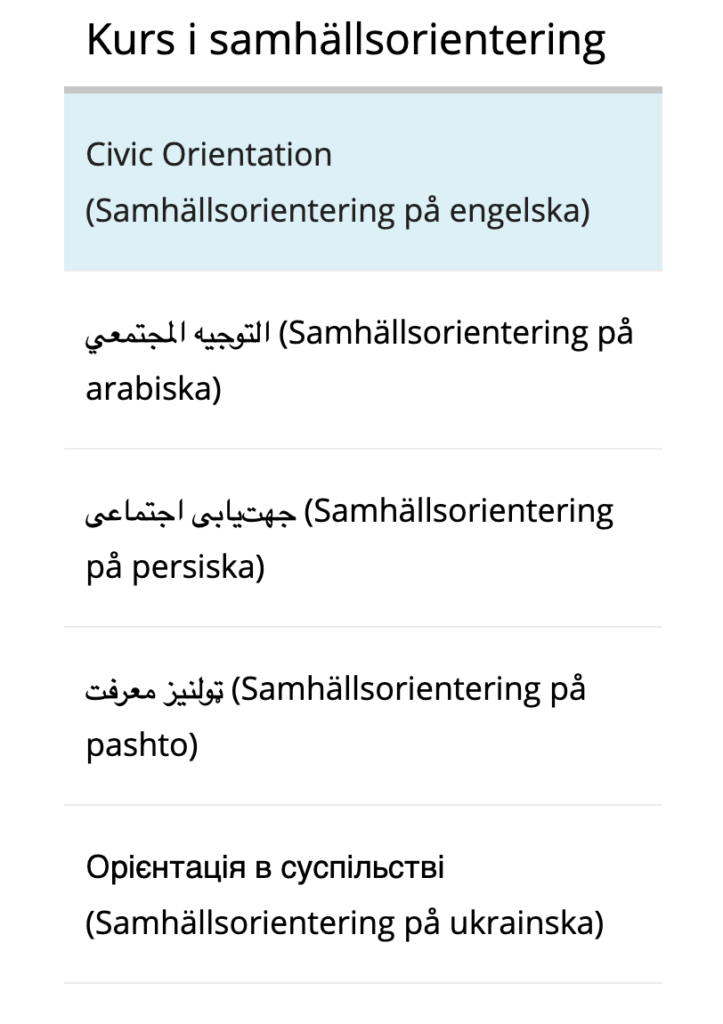
I think one of the positive things about civic orientation that Sweden has done very well, but which is at risk of being taken away due to recent suggestions, is that it has been given in migrants’ first language. Civic orientation classes can be a great place for people to ask questions about everyday things. I think [civic orientation], when it works well and people attend, can also be a great way for the Swedish state to inform people against disinformation campaigns, for example.
But I do think, on the other hand, that when you also tell people about what to eat, what to drink, and how to do specific things. In some of the classes, students were given an exact hour when they had to put their children to bed. When there are also many things like this, then people just think, “Why are we learning about this?”.
When students are given information they think is obvious or not relevant, the risk is that the things that are actually important or helpful, like: In Sweden, it is illegal to hit children, it is illegal to abuse your wife, or your husband for that matter. When this important knowledge is given alongside a lot of strange information, these things might also be seen as less important. I think the state is doing itself a disservice by trying to talk about these things under the same breath.
Q: Does this tie into the more nationalist outlook in civic orientation today, into the process of universal ideas being framed as Swedish?
I think it does. The need for these courses, firstly, shows that the state thinks this is such important information that everyone needs to know it. There are now further suggestions and proposals to have testing both for permanent residency and for citizenship, based on both Swedish language skills and civic information and knowledge. So, what’s taught in these courses will determine whether someone can stay safely in Sweden or not.
So this becomes another step in enforcing this boundary that I was talking about between who we are in the Swedish state and who you are outside it, and what you need to know and do to step into this community.
“It shouldn’t be seen as easy”
Q: Do you have any thoughts on how to reform civic orientation in Sweden?
It’s always hard with specific ideas. I am also not sure I’m the one who should say exactly what to do. But I do think that the idea of dialogue that’s been prominent in Swedish civic orientation, at least in the policy documents, is good and should be encouraged.
I think that what’s been lacking more is more training for the communicators, because what the state is trying to do here is extremely hard. This is something that there are decades of research in many different disciplines—education, linguistics, and political science on how to do. It’s not just something that you can throw someone into and expect them to do very well.
Yes, some very conservative people migrate to Sweden. Some people migrate to Sweden exactly because they’re very progressive and they’re persecuted. So, to really see that the people in the classroom are actually people. Facilitating this kind of open dialogue is extremely hard, but I think [civic education] is an extremely hard thing to do, and it should be seen as that. It shouldn’t be seen as easy.
Adrian Ganic is a M.Sc., THE LONDON SCHOOL OF ECONOMICS AND POLITICAL SCIENCE and a DDRN CORRESPONDENT