 by
by Why Space Matters for Displaced Childhoods?
According to the United Nations High Commissioner for Refugees (UNHCR), an estimated 117.3 million people were forcibly displaced worldwide by the end of 2023, including 47 million children under the age of 18. Millions of children are therefore growing up in displacement, often in environments that were never designed for childhood.
At the same time, United Nations Children’s Fund UNICEF reports that in Syria, reported that 3 million children are internally displaced, with millions out of school or at risk of dropping out. While these figures describe scale, they do not explain how displacement is lived day to day, especially in the spaces where children sleep, wait, and play. For the millions of children behind these figure, those spaces are not just housing; they shape, safety, social and emotional wellbeing, This is where SDG 3 (Good Health and Well-being) becomes relevant, not only as healthcare access, but as the daily lived conditions that determine children’s wellbeing.
This article asks what happens to children’s social lives when the spaces around them were never designed with childhood in mind. It argues that in both Sweden and northern Syria, space operates like a quiet form of governance that regulates children’s movement, limits who they can gather with, and makes belonging fragile which impacts their wellbeing. To examine this, the article draws on qualitative interview material collected for a 2024 master’s thesis, Challenging Childhoods: Children in Refugee Shelters in Sweden and Syria.
Two Settings, Same Mechanism: Space as Rule
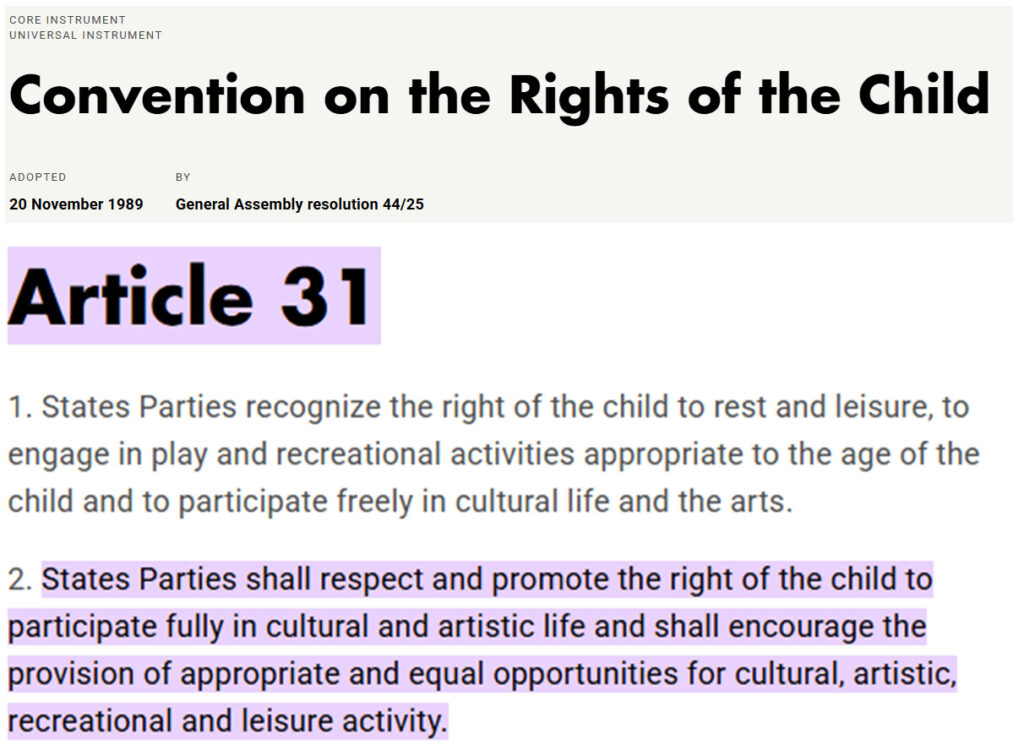
Across both settings, space shapes children’s social lives through movement rules: (where children are allowed or not allowed to be), access to child friendly spaces (where play and friendships can happen), and routine stability (mainly schooling, which determines whether social ties can form and last). What is at stake here is when space functions through permissions and prohibitions, play becomes conditional rather than supported despite the Convention on the Rights of the Child’s Article 31 of children’s right to play.
At first glance, Sweden and Syria represent two completely different displacement realities. However, both reveal how physical environments profoundly shape childhood. In Sweden, refugee shelters are often repurposed buildings like old hotels or unused institutional facilities rented by the Migration Agency. They provide water, electricity, and heating, but space is extremely limited. Rooms often contain two bunk beds and hardly a chair, and younger children are frequently not allowed to move freely. As one worker emphasized repeatedly, “the environment is very limited,” keeping children indoors for most of the day. With no shared spaces and restricted movement, children’s social life in Sweden is pushed indoors and becomes harder to sustain beyond small, unstable interactions.
The tension is clear: even in a welfare state like Sweden, displaced children’s childhoods can be restricted by how institutions manage space. These restrictions are shaped by factors such as, institutional arrangements housing rules and routines, and risk management that prioritise efficiency and adult order over children’s social needs.
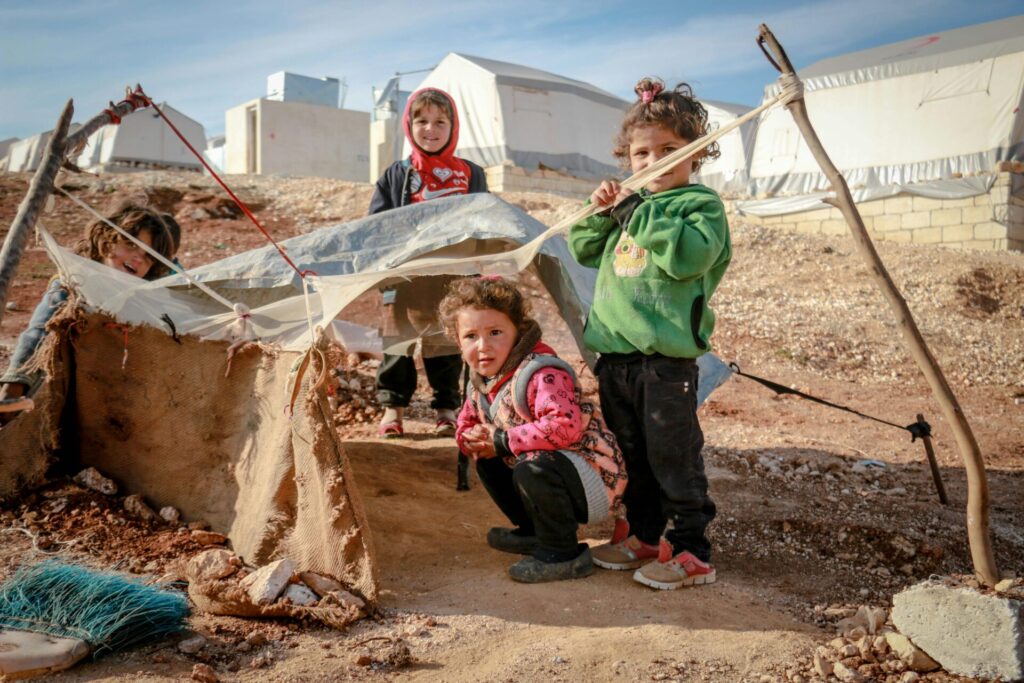
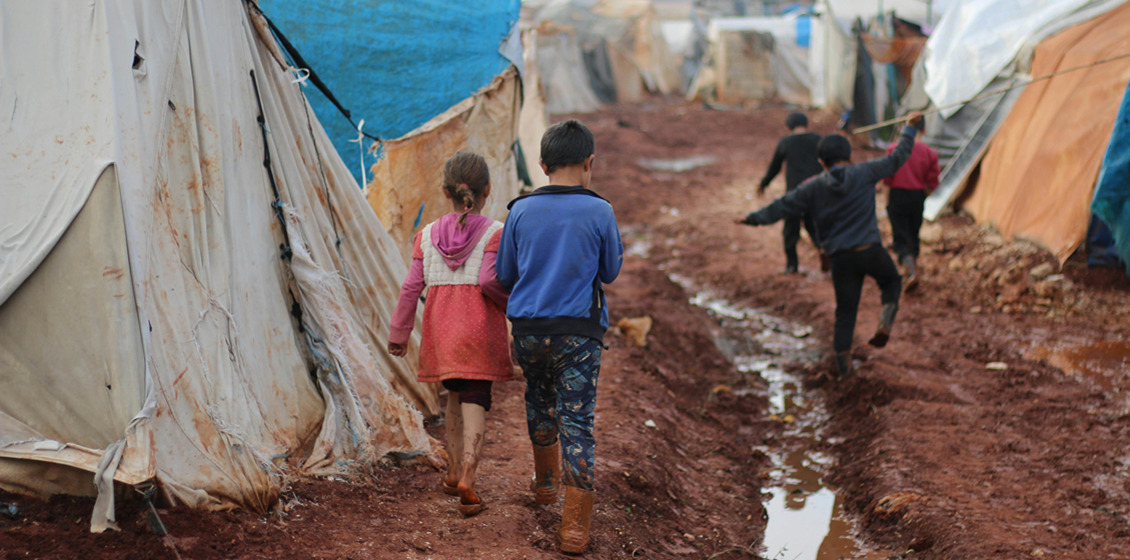
In northern Syria, displacement takes place in open fields and between tents with almost no permanent infrastructure with weather intensifying hardship: winter floods turn the camp paths into deep mud, while summer brings dust and extreme heat. Teachers described children arriving at school “covered in red mud,” worried that their parents would punish them for ruining their clothes. Overcrowding is severe, privacy in tents is non-existent, and daily life is marked by instability. One participant put it, “The camp environment leaves a visible trace on the children’s faces and feet.”
Despite their differences, both contexts share one truth: space is not neutral. For children, it shows up as permissions and prohibitions, whether they can leave, where they can gather, how loudly they can play, and how quickly adults shut down noise and gatherings.
Harsh Living Conditions and Everyday Impacts
Children’s physical and emotional wellbeing is deeply affected by the environments they inhabit, as in Sweden where, overcrowded rooms, the absence of common space in addition to restrictions of movement, create what workers described as an “uninviting” atmosphere. These confinements shrink children’s opportunities to meet others, play freely, and build everyday friendships, Consequently, this affects their wellbeing.
Different in severity, similar in effect: children’s wellbeing is shaped by how space constrains movement, privacy, and social contact. In Syria on the other hand, hardship is far more severe. Interviewees described constant cycles of mud, heat, dust, and flooding. Children fall on their way to school, their books and shoes ruined, their clothes soaked. One teacher recalled how a girl cried in class because she feared her mother’s reaction to her muddy clothes.
The impacts of shelter spaces go beyond weather and clothing. A teacher described a young child experience during visiting a teacher’s home, the girl did not recognise a kitchen sink and asked her mother “what is that?” This unsettling moment reveals how deprivation from basic domestic routines can reshape what children take for granted as everyday life.
In both settings, these conditions shape children’s sense of safety, routine, and dignity and they redefine what children come to accept as normal.
When There is Nowhere to Gather
Across both contexts, one issue stood out clearly: the absence of safe, child friendly spaces.
In Sweden, the only designated child space is a playroom run by Save the Children Sweden volunteers opened only once a week. This provided a rare child centred space, but its limited availability meant that play and social life still had to be negotiated with staff and adults in shared indoor areas the rest of the week resulting to children’s social life being squeezed into leftover spaces such as rooms, hallways when staff can’t see them, rather than having stable places designed for play and connection.
In Syria, the situation is harsher. With no designated play areas, children use narrow gaps between tents, dusty roads, and nearby fields as makeshift playgrounds often unsafe and contested. Learning spaces might have extremely basic activity area, while others offer hazardous outdoor spaces where previous injuries forced teachers to remove playing structures like slides altogether.
Whether it’s a monitored hallway or between tents, play happens only where it is allowed, and when play depends on whatever space is left, children’s social development becomes something they must negotiate. This is a rights issue: target 7 of SDG 11: Sustainable Cities and Communities calls for “universal access to safe, inclusive and accessible, green and public spaces, in particular for women and children.” In displacement, that public space is often a corridor, a tent path, or an unsafe field space that limit who children can meet and how they can play.
School as the Only Stable Social Space
Space also impacts access to education in unequal ways in refugee shelters. In Sweden, many children in temporary shelters cannot attend school because they lack a stable address or personal identification number. Families often hesitate to enrol their children because relocation can happen at any moment. As one worker explained, “They are waiting without any schooling.” Thus, When the playroom is the only social space, structured activities can compete with children’s need for free play and peer time.
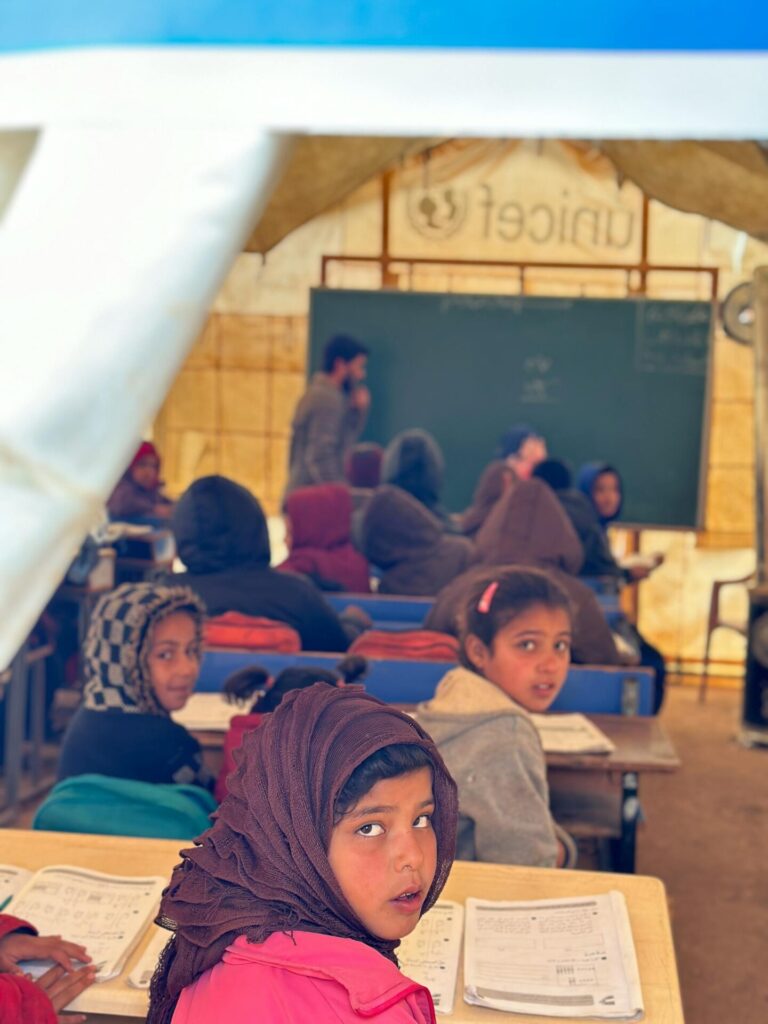
In Syria, schools exist inside camps, but access remains extremely fragile. rooms built with low ceilings of tent fabric, overcrowded quickly leads to limited ventilation, making it harder for children to focus, stay in class, and keep school as a stable social space.
Additionally, hazard list is long. Children walk long distances through mud, heat, and rain. Also, stray dogs, unsafe streets crossings, and floodings pose daily dangers. Many miss school to work in agriculture with their families. Poverty prevents parents from providing shoes, clothes, or school materials. However, teachers consistently reported children describing school as the “most pleasant place” because it offers them rare moments of routine and stability in camp life.
Across both contexts, school is a fragile opportunity that is easily interrupted several factors. When school is interrupted or inaccessible, children lose more than learning time, they lose one of the few spaces where peer relationships, language practice, and everyday belonging can become stable.
Friendships and Social Life Under Physical Constraint
Children’s social relationships in refugee shelters are shaped by space, proximity, language, age, gender, and cultural background and in both settings children constantly negotiate where and how they are allowed to socialize.
In Sweden, play is rare and often pushed into corridors, where staff intervene and send children back to their rooms. Without stable schooling and shared common spaces, children’s social life depends largely on adult-organised opportunities to meet.
In Syria, social life of children is often fragile as the spaces where they can play safely, and with whom, are constantly negotiated. Proximity is decisive, children play with neighbours, relatives who live close, even then play can be challenging as adults shout at them when the ball falls on a tent or gets inside one and in other cases chase them out of fields to protect crops. In this context, children’s play should not be read as evidence that conditions are adequate, but as adaptive practices that emerge despite limited compliance with Article 31 of the CRC.
Children Reclaiming Spaces
Despite restrictions, children show clear agency, not by escaping constraints, but by negotiating them whether in Sweden shelter where children repurpose limited indoor space for play, adapt rules to include one another, and ask for more access to child-friendly space, or in Syrian camp where children similarly improvise with whatever is available and adjust quickly when adults intervene, shifting location or changing games.
Here, adaptation is not symbolic, it is survival, creativity, and resistance integrated in everyday life. However, this agency should not be romanticised as children’s creativity often shows what they are forced to compensate for, specially within such environments that even basic life conditions are not available.
From Adaptation to Responsibility
Rather than relying on children’s ability to adapt to extreme situations, Life environments that better support everyday childhood. This includes shelter conditions that offer adequate space, and a basic level of privacy, as well as better protection from heat, flooding, and overcrowding. Child friendly spaces also matter not only in principle, but in practice: when play areas are consistently accessible, rather than dependent on intermittent volunteer presence, children have better opportunities for social interactions and emotional development. Education is another key space where flexibility matters. Systems that allow children remain connected to schooling despite frequent movement can help preserve routines and peer relationships and consequently children’s wellbeing. In camp settings, safe routes and basics like season proof living spaces and classrooms make school attendance possible throughout the year.
Finally, refugee shelters shape childhood in practical, everyday ways: they decide where children can move, where they can gather, and whether routines like school can stabilise social life. While children adapt with creativity, it often reveals what they are forced to compensate for. The 2030 Agenda’s promise to “leave no one behind” only becomes real when shelter design, play spaces, and school access are treated as part of children’s wellbeing not as optional extras. So, if space shapes childhood, then reimagining displacement spaces is a shared responsibility.
Ola Sobh is Master’s student in Social Sciences – Child Studies at Linköping University, Sweden, and DDRN Intern.