 by
by What is happening to Development Studies? Once conceived as a multidisciplinary field with its own identity, it increasingly resembles a space where researchers hold “double loyalties”: they belong to traditional disciplines but conduct research on development. In Sweden, this trend is especially stark. “Out of more than 100 PhD programmes in Sweden of relevance for development, none were trained purely within Development Studies,” says Professor Fredrik Söderbaum.
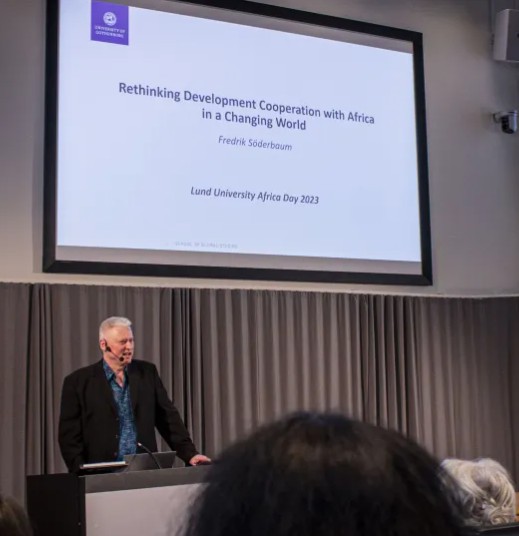
Söderbaum is a professor of Peace and Development Research at the School of Global Studies, University of Gothenburg. In 2021, he initiated a debate as chair of a roundtable session entitled “Development Thinking in Flux – Continuity and/or Change” at the DevRes Conference on Advancing Sustainable Transformation, organised by the Swedish Development Research Network (SweDev). The discussion centred on how “development research” should be defined and where the field is heading.
Four years later, we speak with Söderbaum to revisit those questions and explore the insights shaping the future of Development Studies. In this article, we examine the multiple dimensions of the field, the tensions that define it and the evolving process of decolonising research. We ask: how has the field evolved in recent years, and what might its future look like?
Development studies as a multidimensional (and fragmented) field
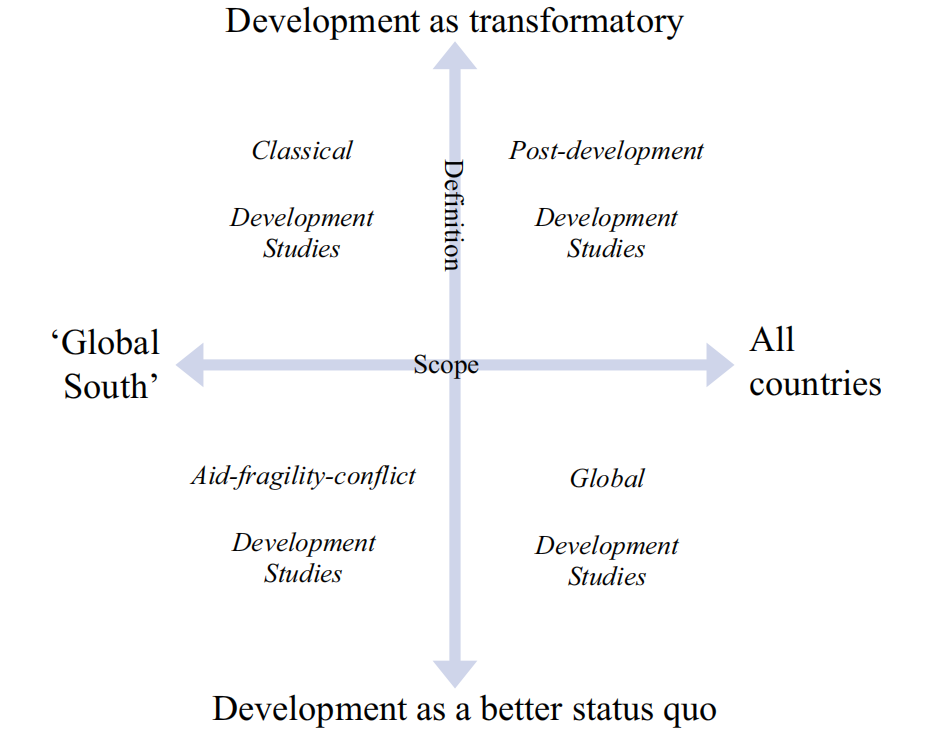
A key feature of the current status of Development Studies is the ongoing internal fragmentation. The scholar Andy Sumner describes this reality as ‘unity in diversity’, suggesting that the field can no longer be understood as a homogeneous body of knowledge, but rather as a space divided by at least four major schools of thought. These differ significantly in how they define ‘development’, whether it can be considered a universal process, and what the role of academic knowledge should be in the face of global inequalities. Rather than offering a synthesis, Sumner aims to make these differences visible and encourage dialogue between them.
For Fredrik Söderbaum, this fragmentation is reflected very concretely in academic practice. Most researchers in development do not identify exclusively with Development Studies, but maintain what he calls ‘dual loyalties’: they belong to other established disciplines, such as economics, political science, sociology or peace studies, and approach development issues from these perspectives. In this scenario, Development Studies functions less as an autonomous discipline and more as a meeting place for diverse approaches.
This situation has fed a persistent tension between disciplinary and interdisciplinary approaches. For years, this debate was framed in almost exclusive terms. However, Söderbaum points out that researchers have begun to accept that both perspectives must coexist. Disciplinary specialisation provides methodological rigour and academic recognition, while interdisciplinary approaches allow for a holistic view of complex processes that cannot be reduced to a single dimension, whether it is economic, political, or social.
The case of Sweden illustrates these tensions well. According to Söderbaum, Development Studies are currently institutionally weak: there is little specific funding, few dedicated academic spaces, and no PhD programmes exclusively identified with the field. These weaknesses are reinforced by the sudden funding scrap in the field due to the current government’s action, which has been remarkable considering the substantial funding that Development research previously received. This situation contrasts with the United Kingdom, where Development Studies continue to be the subject of active debate and have more consolidated institutional structures.
From a critical perspective, it can be argued that Development Studies, at least in Sweden, have become a ‘field without a home.’ Too disciplinary, they risk losing sight of the big picture; too interdisciplinary, their academic rigour may be called into question. The challenge, as Söderbaum suggests, is not to resolve this tension, but to learn to live with it.
“Global South”: A key concept on debate
The concept of the Global South, central to Development Studies, is the subject of ongoing debate. For Fredrik Söderbaum, one of the main difficulties lies in the reality that the term defines. In its most widespread version, the Global South is defined as a geographical category that groups together low-income countries. This interpretation, he warns, is simplistic and obscures the diversity of political, economic and social trajectories that exist between and within these countries.
In contrast to this view, other approaches understand the Global South as a relational category, linked to structural inequalities rather than territorial boundaries. From this perspective, the ‘South’ is not limited to certain countries but can also be found in impoverished regions and communities of developed economies. Söderbaum recognises the analytical value of this interpretation, but points out that, taken to the extreme, it can blur the concept to the point where it becomes difficult to operationalise in empirical research.
This conceptual ambiguity is not an isolated problem, but a reflection of the broader tensions running through Development Studies. When the fundamental categories of the field become unstable, comparing cases, formulating diagnoses, or designing coherent interventions also becomes more complex.
These discussions inevitably open the door to another central debate: who produces knowledge about development and from what perspectives, a question that lies at the heart of efforts to decolonise research.
Decolonising research: despite progress, it remains a utopian ideal
According to Fredrik Söderbaum, the process of decolonising research can be understood in terms of two core dimensions. The first is representation: who produces knowledge about development and from where. The second is perspectives: which theoretical frameworks, concepts and ways of understanding development are considered.
In recent years, progress has been made on both fronts, especially in terms of representation. The presence of researchers from the Global South in international academic debates has increased, and there is greater critical awareness of the extractive dynamics that have historically marked the production of knowledge in this field. The debate on decolonisation is now open and visible and has contributed to questioning assumptions that were previously taken for granted.
Nevertheless, limitations remain profound. Söderbaum points out that many researchers from the Global South continue to pursue their careers at universities in the Global North, which reproduces structural inequalities in access to resources, funding, and academic recognition. Regional differences are marked: while in parts of Asia, such as China, knowledge production has grown significantly, in Africa, changes are slower, and no substantial transformation is expected in the short term.
From this approach, decolonisation appears to be a morally desirable goal, but one that is difficult to achieve fully. Without institutional reforms that modify the structures of funding, publication and academic evaluation, there is a risk that the debate will remain at a symbolic level.
Regarding the perspectives, the issue becomes more complex. Decolonial perspectives exist both in North and South, and they both remain weaker than mainstream. Whereas in the North, they appear to be stronger, they are often appropriated by mainstream actors and not always aligned with development problems and agents in the Global South. In the South, a division is clear: while for some, decolonising perspectives are a priority, for others, it has no importance at all.
A field in crisis or in transformation?
Development Studies is not facing a crisis of relevance, but rather a crisis of identity. Far from disappearing, the field continues to generate research, attract scholars and drive fundamental debates on inequality, power relations and social transformation. However, it does so from a fragmented position, marked by conceptual, institutional and epistemological tensions.
As both Andy Sumner’s proposed framework and Fredrik Söderbaum’s reflections show, this fragmentation is not necessarily a weakness. Rather, it can be understood as the result of a field that resists simplifying complex realities. Development Studies is the only field which, at least potentially, addresses development in a holistic manner. The challenge is not to restore a lost unity, but to create spaces for dialogue between different approaches, diverse disciplines, and unequally represented voices.
In a global context marked by multiple conflicts, abandoning development research is not an option. The task, as Söderbaum suggests, is to continue doing development studies, and it is essential to do so from a critical, conscious, and open approach to diversity.
Here, it is also appropriate to add that this weakness has been reinforced by the fact that the current government suddenly scrapped all funding for development research in Sweden—a field that has previously received rather substantial funding.