 by
by Climate change is often discussed through science, emissions targets, and environmental disasters. Yet behind global climate action lies another, less visible process: climate diplomacy. Broadly, climate diplomacy refers to the negotiations and cooperation between countries aimed at addressing climate change through international agreements, policy commitments, and collective action.
As climate decisions shape the future of younger generations, youth participation in these discussions has become increasingly important. While many associate youth climate engagement with protests and activism, young people are also participating in policy consultations, advocacy networks, educational initiatives, and climate diplomacy forums.
To better understand what youth engagement in climate diplomacy looks like in practice, I spoke with the hosts of Young, Loud and Green, Natalia Vradi, and Ioanna Giakoumopoulou, two young women from Greece who are actively involved in climate advocacy. Through conversations with climate experts, researchers, and youth leaders, the podcast explores climate diplomacy, sustainability, and civic participation, while making these discussions more accessible to younger audiences.
How Two Young Researchers Found Their Path into Climate Diplomacy
Both interviewees described their entry into climate-related work as closely linked to their academic experiences, but also to the people and environments that shaped their interest in the subject.
Natalia Vradi studied Political Science and Public Administration before completing a master’s degree in Southeastern European Studies. She explained that her interest in climate diplomacy was first sparked during her undergraduate studies, when she attended a course taught by a relatively young professor specializing in the topic. She emphasized that the professor’s age and teaching style made a significant difference in how engaging and accessible the subject felt, particularly because climate diplomacy is often perceived as distant or overly technical. This early exposure helped her recognize climate change not only as an environmental issue, but as a political and diplomatic process shaped through negotiation and international cooperation.
Ioanna studied International Relations with History and also holds a master’s degree in Southeastern European Studies. Her engagement with climate-related work developed more gradually through her broader interest in youth participation, civic engagement, and what it means for young people to be actively involved in political and social processes. Interestingly, she also noted that her deeper involvement in climate diplomacy was influenced through her collaboration and connection with Natalia, highlighting how peer networks and shared academic environments can play a key role in shaping professional pathways.
Taken together, their experiences underline the importance of accessible education and relatable mentorship in climate-related fields. Having educators and peers who are close in age or who actively engage with the subject in an approachable way can significantly lower the barrier to entry for complex topics such as climate diplomacy, making them feel more tangible and relevant to younger students.
What youth participation in climate diplomacy looks like
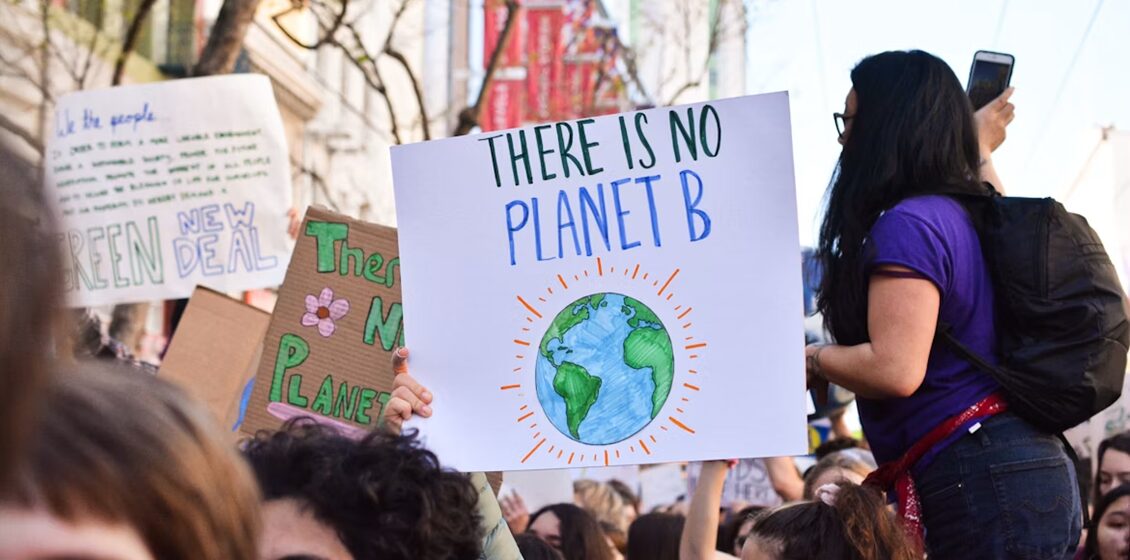
When asked what youth engagement in climate diplomacy looks like in practice, the hosts said that, unfortunately, it is still largely associated with protests and street activism. They noted that while movements such as Fridays for Future have played a crucial role in raising global awareness of the climate crisis, protest remains the most visible and accessible form of engagement for many young people.
At the same time, they explained that youth participation is not limited to activism in the streets. Other forms do exist, including policy consultations, youth delegations at international conferences, participation in climate forums, research contributions, and engagement through youth-led networks and educational initiatives. However, they emphasized that these forms of participation are often less visible and do not necessarily translate into real influence within formal decision-making processes.
When asked about this gap between participation and influence, they pointed to what is often described as “youth washing.” They said that institutions frequently highlight the presence of young people in conferences, consultations, or advisory spaces as proof of inclusivity. However, in many cases, this presence does not necessarily lead to meaningful involvement in shaping decisions.
As they explained, the core issue lies in the difference between being included in a space and having actual decision-making power within it. While youth participation is increasingly acknowledged in principle, it does not always result in concrete policy impact.
Barriers to meaningful participation
Several structural barriers were identified as limiting young people’s ability to engage effectively in climate diplomacy.
Funding was highlighted as one of the most significant obstacles. Much youth participation depends on unpaid or voluntary work, which excludes those without financial support or flexibility. Age was also discussed as a persistent barrier, with younger participants often not being taken as seriously in formal institutional settings.
More broadly, the interviewees pointed to a lack of clear mechanisms through which youth contributions are translated into policy outcomes. Even when young people are consulted, their recommendations are not always reflected in final decisions.
Youth Networks Beyond Borders
When asked whether they could point to examples of youth-led initiatives that have had a tangible impact in climate spaces, the hosts referred to a discussion they had in one of their episodes from their podcast. In the episode, they spoke with Michael Kakande, a United Nations Climate Change COP Impact Maker and the Founder and Chairperson of Resilient40 (R40), a Pan-African and diaspora youth-led network focused on climate resilience, adaptation, and climate justice across Africa.
They described Resilient40 as a network that brings together young professionals from across the African continent and diaspora to amplify youth voices that are often underrepresented in global climate discussions. According to the interviewees, its work is particularly focused on ensuring that African perspectives are meaningfully included in international climate negotiations, especially in key policy areas such as climate finance, adaptation strategies, and loss and damage.
In their view, initiatives like Resilient40 illustrate that youth engagement in climate diplomacy is not confined to local activism or awareness campaigns. Instead, it increasingly takes the form of structured, cross-border collaboration that connects young people across regions and institutional contexts.
They added that this reflects a broader trend in climate advocacy: youth participation is becoming more global and interconnected, shaped by networks that operate across both the Global North and Global South. Rather than acting in isolation, young climate advocates are increasingly engaging in transnational spaces where knowledge, strategies, and political demands are exchanged and amplified across borders.
Misconceptions About Youth in Climate Governance
The interviewees addressed a recurring misconception about youth participation in climate governance: the assumption that young people lack the expertise, experience, or technical knowledge necessary to contribute meaningfully to policy discussions. They firmly challenged this notion, arguing that many youth-led initiatives comprise highly informed participants who actively engage with complex areas like climate diplomacy, negotiation processes, and international frameworks. In their experience, young leaders are often deeply embedded in research, advocacy, and policy-oriented debates, making them well-versed in both the scientific and political dimensions of climate change.
To combat this skepticism, they use their podcast to directly showcase the sophisticated capability of the youth movement. The podcast highlights the sophisticated professionalism of the youth movement, featuring, as Ioanna noted, “fantastic guests, who are so involved in this and so passionate and well educated.” By centering these conversations, the podcast proves that young climate actors are highly informed, serious leaders who deserve a seat at the table.
This effort to shift the narrative extends to the Youth Climate Diplomacy Forum itself. Ioanna highlighted that the Forum delivers “top-tier conferences and content” entirely produced by individuals “under the age of 35,” showcasing the undeniable professionalism and active engagement within the youth climate movement.
Ultimately,the interviewees stressed that the issue is not a lack of competence among young people, but rather a structural tendency to undervalue their contributions. Even when youth are present in formal settings, their input is not always treated with the same seriousness as that of older or more established actors, creating a gap between participation and recognition.
A Source of Hope: The Next Generation of Climate Engagement
When asked whether the future of youth climate advocacy and diplomacy offers genuine hope or if the movement is destined to stagnate, the interviewees pointed directly to the surging momentum of grassroots engagement.
For them, hope is not an abstract concept, but something visible in the sheer volume and sincerity of the young people getting involved. They noted that the next generation of advocates is not merely “showing up for the pictures,” but is driven by a deep, authentic interest in systemic change. There is an undeniable strength in numbers, evidenced by the rapid growth of youth organizations and the massive turnout at local initiatives.
This momentum is particularly vibrant on a local scale. In Athens alone, a booming ecosystem of youth-led solidarity initiatives has emerged. From youth-run magazines and massive tree-planting events to beach cleanups and climate-conscious fashion swaps, the sheer variety of active projects offers a daily dose of optimism. Social media has played a vital role in this expansion, making it easier than ever for young people to discover a clothing swap one day and a coastal cleanup the next.
Ultimately, they agreed that climate engagement has grown exponentially over the past few years, largely because the crisis itself has become impossible to ignore. As they poignantly noted, it is both a blessing and a curse: while the severity of the crisis forces people to action, the reality of climate change is now as simple and undeniable as opening a window and looking outside. Yet, in the face of that reality, the rapid proliferation of new, youth-led initiatives remains their greatest source of hope.
From Presence to Power
Youth engagement in climate governance has evolved far beyond the boundaries of traditional street protest, turning into a highly strategic and professionalized movement. Through the experiences and insights shared in this interview, it is clear that despite facing steep structural barriers like funding limitations and the persistent threat of “youth washing,” young advocates are operating with a sophisticated level of technical expertise and cross-border solidarity. The sheer momentum of these grassroots initiatives shows that the next generation is no longer just asking for a seat at the table; they are actively reshaping the dialogue. In the face of an escalating crisis, their deeply informed engagement provides a vital reminder that meaningful climate action is impossible without recognizing youth not just as observers, but as essential partners in driving real policy change.
*Special thanks to Natalia Vradi and Ioanna Giakoumopoulou for sharing their time, experiences, and vital insights into the future of youth climate diplomacy.
Sofia Kiryttopoulou is studying for a Bachelor’s Degree in Balkan, Slavic and Oriental Studies. Specialization: Politics and Law, at University of Macedonia, Thessaloniki, Greece.