 by
by Let’s go back to my family home, around 15 years ago. Imagine that my family and I are all waiting impatiently for the person that was then considered to be a legend, the one and only Bassem Youssef. This heart-surgeon turned political satirist was our only comfort during uncertain times. You see, growing up in Egypt means you have to learn a couple of things about what to say, and more importantly, what not to say. Especially in regards to the political scene. You get told this all your life, and suddenly there is this guy making jokes and bashing out every single politician there is. Crazy man! What was even crazier was how right he was.
And funny. But most importantly, right. He took common issues that people were not able to publicly speak about, spoke about them on national television, and with full confidence. As much as I would love to make it seem as
though I fully understood what he was saying at the time, I can’t. I was in fact 10 years old, and thought that the guy was funny.
I asked my parents about how come people are unable to speak up about what bothers them within the political sphere, but this guy was able to say whatever he wanted *as a joke.*
That is when I found out about satire. (Which I also did not fully understand at the time, but I digress). I learned that satire was a form of humour used to expose hypocrisy, contradictions, and absurdity. Or, as I would later learn from Dr. Ida Klitgård (don’t worry, she will be introduced in the next paragraph), a way of shifting our focus to notice the underlying truth.
Which can only mean one thing: satire may be funny, but its impact reaches far beyond a quick laugh. From exposing political hypocrisy to influencing public opinion, satire has long occupied a unique space between entertainment and dissent. To better understand its role in contemporary politics, or more so our daily lives, I had the honour to virtually interview Dr. Ida Klitgård. Dr. Ida Klitgård is an Associate Professor at Roskilde University, in Denmark, whose research examines language, culture, and the ways ideas circulate across societies. Dr. Ida Klitgård is also the Principal Investigator of the SatiReNet. Which means she is probably funny. And definitely very smart.
Back to my 10-year-old self, I didn’t really understand why the people in power were so scared of a guy telling jokes. Surely being president, minister, or whatever title people have comes with enough confidence to survive being the butt of a joke. But I guess not. So I asked Dr. Ida Klitgård why satire seems to provoke such strong reactions.
Dr. Ida Klitgård connected this to what is known as the “alienation effect,” a concept that essentially means creating enough distance from something familiar so that we are able to see it differently1. Which sounds very academic. Until you realise that Bassem Youssef built an entire career around it. Egyptians had already seen the politicians he was mocking. They had heard the speeches. They had watched the interviews. Nothing he showed his audience was new. Yet somehow, by placing those clips inside a comedy show, they looked completely different. Not because people were incapable of noticing contradictions before, but because once somebody points them out publicly, they become much harder to ignore.
So you know that joke that goes “what do you call a politician with half a brain? Gifted!” ? Well, you get the point.
What surprised me most during my conversation with Dr. Ida Klitgård, however, was not her explanation of why satire is powerful. It was rather her observation that people in power have started using the same tools themselves. Traditionally, satire worked in one direction. The jester mocked the king. The comedian mocked the politician. The people mocked those making decisions on their behalf. Nature was fine. But unfortunately not anymore. This tool is just not as satisfying anymore. Where is the need for a joke to expose ridiculousness, when people are exposing themselves already? Why do they need to take this from us as well? As Dr. Ida Klitgård pointed out, politicians now make memes. Governments publish provocative videos. Public figures say outrageous things and then hide behind “it was just a joke” when they face criticism.
SO unfair!
But to this, Dr. Ida Klitgård opened my eyes again. The belief that satire should “punch up” at power rather than “punch down” at marginalised groups is not correct. Apparently, satire does not lose its legitimacy when it targets the “vulnerable” rather than the “powerful.” To illustrate this point, Dr. Ida Klitgård pointed to the Danish playwright Ludvig Holberg. In works such as Jeppe på Bjerget, Holberg often mocked ordinary people rather than those in power.
From a “modern” perspective, this might look like “punching down.” However, Klitgård argued that Holberg’s intention was to expose what he saw as superstition and poor reasoning, ultimately encouraging change through education.
I don’t want to get into my views of education and what it means to have a good or bad education, as this opens the door massively to arguments that I’m not ready to have. What struck me about Dr. Ida Klitgård’s answer was not necessarily that I agreed with it. It was that it forced me to rethink something I had always assumed was true. Growing up with Bassem Youssef, I had subconsciously placed satire on the side of the “good guys.” Satire challenged power, exposed hypocrisy. It comforted people when politics became absurd. In my mind, it was an inherently rebellious concept. But unfortunately, life is not that simple.
Dr. Ida Klitgård’s point was not that satire should punch down. Rather, it was that satire itself has no built-in moral compass. It is a tool. The same mechanism that exposes a dictator can be used to ridicule immigrants. The same humour that empowers one group can humiliate another. Which is an uncomfortable thought. I wanted to make satire seem like some kind of friendly neighbourhood Spiderman! But satire is a double-edged sword. The question is not whether it is good or bad, for everything has good and bad. Rather, who is using it and what is their intention behind it.
Why can’t we have ONE thing?
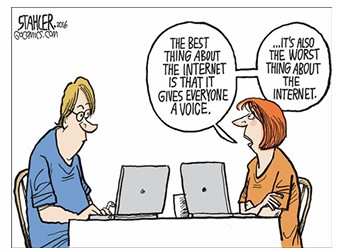
Unfortunately, Dr. Ida Klitgård was not done ruining my simplistic understanding of satire (which I am very grateful for). As if discovering that satire is not inherently good or bad was not enough, there is also the matter of social media. Satire felt easy to identify. Political crisis. Someone made fun of it. Haha. Move on. But now everyone has a platform, the satirist, the politician, the conspiracy theorist, and even flat-earthers! But according to Dr. Ida Klitgård, this has fundamentally changed the role of satire. She explained that satire has become democratised.
Everybody can now participate in it. This has made satire both a gift and a weapon. On one hand, more people are able to challenge power and participate in public debate. On the other, those same tools can be used to spread hostility, ridicule, and division. I asked whether social media was helping “democracy” (whatever that is) or destroying it? Dr. Ida Klitgård’s answer was “yes.”
Anyway, let us go back to Bassem Youssef’s Al Bernameg for a second. In one episode, the show performed a song titled “After the Revolution, We Got a President.” On the surface, it was just another comedy sketch. Beneath that, it was a masterclass in what Dr. Ida Klitgård described as the “alienation effect.”
Youssef would begin every episode with a disclaimer insisting that the programme was fictional, comedic, and entirely disconnected from reality. Then, moments later, he would play actual clips from politicians and television presenters. The contrast was impossible to ignore: the “fictional” comedic programme was more honest than the news. Who knew that was possible?
Anyway, if you’ve read my latest article, you’ll know that colonialism is one of my recurring topics to write about and discuss. A close second is racism. I like to keep things cheerful. So the question “Satire can be used as a hidden tool for racism. Do you agree? Or is it all sh*ts and giggles?” arose.
The answer of Dr. Ida Klitgård really opened my eyes, as with the rise of the far right in Europe within the area where I live, it is sometimes hard to take a step back and think objectively whether something is serious or meant as a joke. According to Dr. Ida Klitgård, satire can absolutely be used as a tool for racism. “If someone believes that race, ethnicity, or migration represents a social problem, they may use satire to ridicule those groups in the name of ‘correcting’ what they perceive to be wrong.”
Which brings me to Friedrich Merz. In August 2025, the German Chancellor proudly announced that asylum applications had been reduced by 60% compared to the previous year. He then added that there was still a “problem” visible in the “cityscape” of German city centres and that the Interior Minister was therefore working to make deportations possible on a much larger scale.2
You might be asking yourself, what does the architecture and “cityscape” of a city have to do with deportation? You are on the right track…Anywho, I am not a comedian. Living in Germany has made that abundantly clear. But thankfully, here there is no need to come up with a joke. This is where satire becomes interesting. Not because it invents absurdities, but because it points to absurdities that already exist and asks the audience to sit with them for a little longer than is comfortable. My realisation was that I, apparently, am not pretty enough for Friedrich Merz or his “cityscape.”
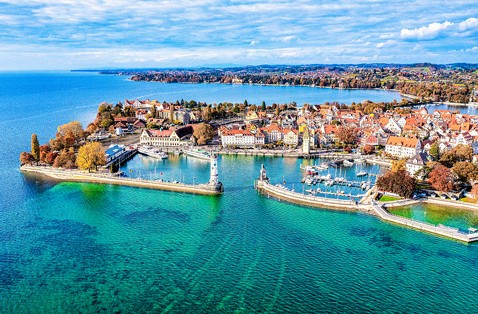
What do immigrants have to do with this? What does the ugly city centre of Konstanz have to do with immigrants? FYI, Konstanz is very pretty… (see the picture). Moving on…
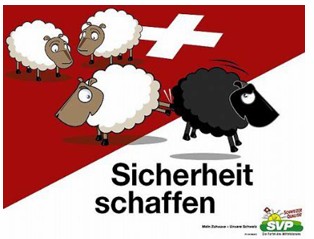
Dr. Ida Klitgård argued that satire is ultimately shaped by the values of the satirist. Anything can become an object of satire if the satirist believes it should be improved. The problem begins when satire loses its larger purpose and becomes bullying, mockery, or harassment. Which brings me to one final example. A Swiss political party once portrayed immigrants as black sheep and “indigenous” Swiss people as white sheep.3 Now, I am not entirely sure who approved that campaign. What I do know, though, is that Switzerland is famously proud of its black-nosed sheep.4 The line between political messaging, satire, and self-parody has suddenly become very difficult to identify. Which is precisely the problem.
So thanks to Dr. Ida Klitgård, all my assumptions about satire have been crushed. I thought satire was about humour, turn’s out it’s about truth. I thought it was there to challenge power, now those in power use it too (but don’t challenge themselves). I thought satire was OUR thing, turns out satire does not care who uses it.
I thought Bassem Youseff was funny. Turns out he is a big, scary man. Oh. LOL. Satire is not all sh*its and giggles.
“Creating Security,” by the Schweizer Volks Partei (the Swiss Peoples’ Party)
Maya Rakha has a Master’s Degree of Arts in International Security at University of Groningen and is a DDRN Correspondent