

 by
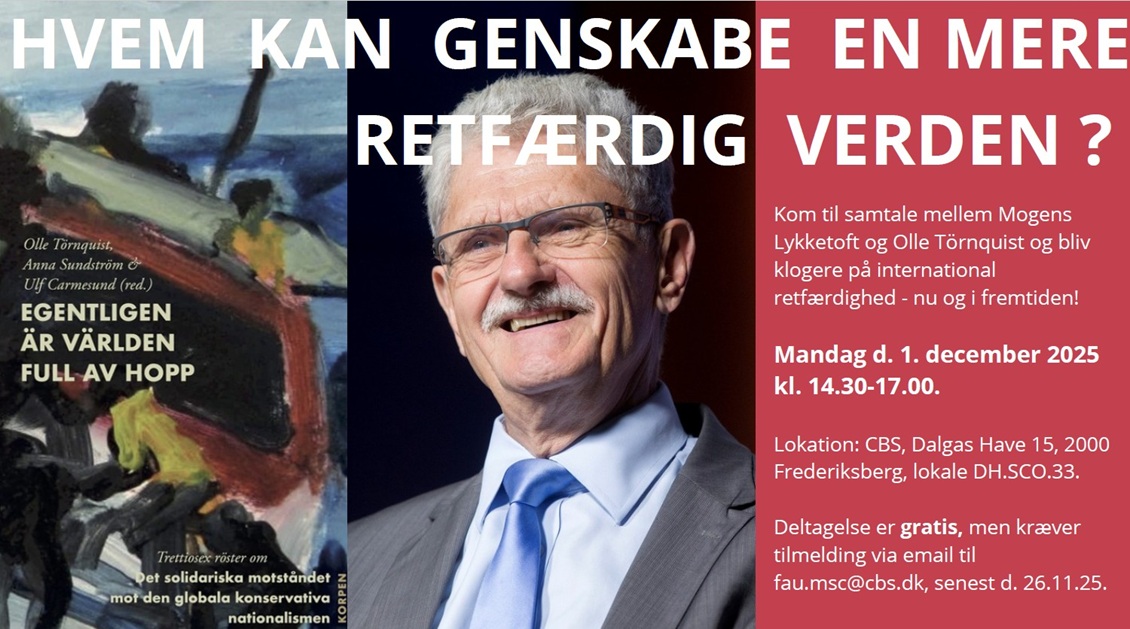
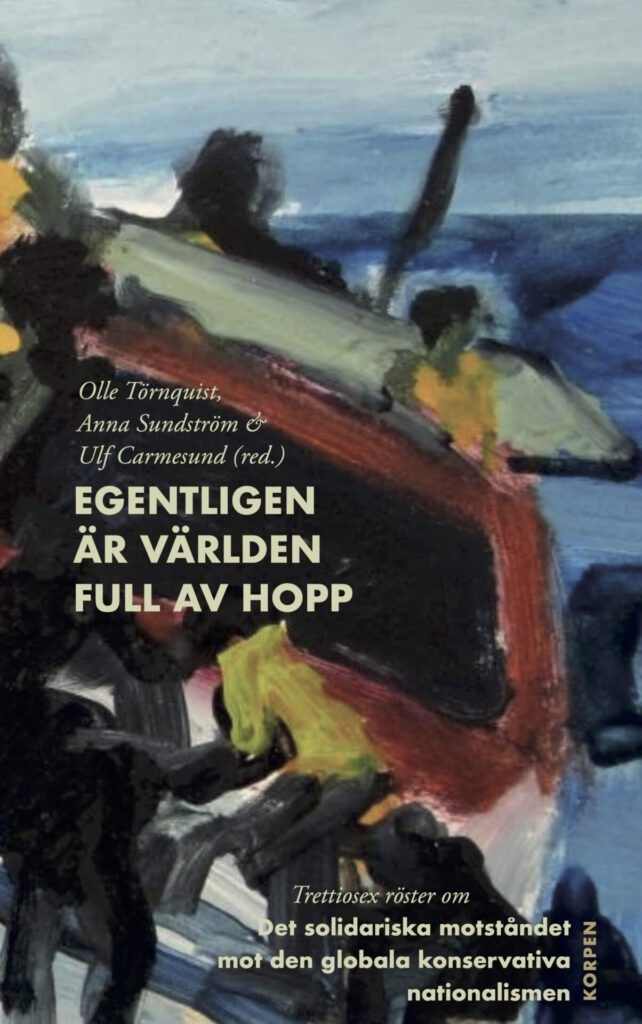
by Review of Egenligen är Världen Full av Hopp. Trettiosex röster om Det solidariske motståndet mot den globala konservativa nationalisme. Edited by Olle Törnquist, Anna Sundström & Ulf Camesund, Korpen Publishers, Göteborg, Sweden 2025. (Actually, the World is Full of Hope. Thirty-six votes on the solidarity resistance to global conservative nationalism. Edited by Olle Törnquist, Anna Sundström & Ulf Camesund, Korpen Publishers, Gothenburg, Sweden 2025. 609 pages)
With a rewrite of the Communist Manifesto “a spectre is haunting the world” – the spectre of right-wing ideology, nationalism and global conservative nationalism is haunting the world in 2025-2026. Remigration, islamophobia and regression have replaced globalization, neoliberalism, open borders and a humane policy towards migration. Free trade has morphed into protectionism and in the global North (members of the EU) there are serious calls for militarization and cuts in ODA with grave consequences for aid dependent countries in the global South both in terms of lack of solidarity and negative impact on climate change and the environment. Rearmament and a whopping increase in military spending of 5 % of GDP is a response to Russia’s war in Ukraine. The former European colonial powers invoke heavy sanctions on Russia while Israels genocidal slaughterhouse in Gaza does not seem to bother that much except at a rhetorical level. This shows a tremendous degree of hypocrisy and double standards with grave consequences for the functioning of the liberal international order and international law in general.
The contribution under review here is a timely response to these U-turns in international relations. It is a call for hope. For reintroduction of solidarity, equality and fraternity. It is a decent attempt to explain the root causes of populism, global national conservatism and why working classes in the North feel disadvantaged and left in the cold due to outsourcing, loss of employment and deindustrialization in general.
International solidarity
According to one of the lead authors, Olle Törnquist, we live in times of dystopian crises. Everything in the international arena has been turned upside down. The culprit has for a long time been neoliberal globalization, but it has been supplemented by a wave of conservative nationalism which refer to a degree of authoritarianism based on a nativist and exclusive emphasis on citizenship.
The book is an attempt to challenge this right-wing turn by re-establishing a counter movement based on a new non-aligned movement between progressive forced focusing on solidarity, democracy and sustainable development. The basis of international solidarity refers to the former Swedish Prime minister Oluf Palme’s dictum regarding the combined focus on internationalism and welfare. It is an ambitious attempt to revitalize international Keynesianism and international solidarity.
In chapter 32 Pierre Schori refers to Oluf Palme’s work for our collective engagement in support of progress and peace in Sweden and in the world: “It would sound false that we work for equalization and equality within our own country but ignored the world’s starving millions. And in the same way, it would ring false if we spoke ever so vaguely about aid to the poor people, if we at the same time allowed class divisions and income differences to grow in our own country. There must be a connection between what we are working for in your own country and what we stand for internationally.” The aim was to create a new economic world order. More equal and based on partnership.
The core of the social democratic idea is interest-based social movements, democracy and human rights, rights-based welfare and broad social agreements about sustainable development. It is all about taming capital, protest it, change it or leave it altogether. These visions did not materialize although Palme did receive support from Willy Brandt and others from the Socialist International and the South. These were real statesmen not technocrats or political bureaucrats without a positive agenda.
What is the new international conservatism?
Chapter 27 by Aase Mygind Madsen explains the raison d’etre of the new far right movement in the US and EU which rely on a belief in strengthening nation-states territorial integrity and citizens’ rights against globalization. Authoritarian nation-states promote a political project based on exclusive citizens’ rights based on blood ties, birth, cultural sovereignty and natives’ culture and religion. It is against multilateralism, diplomacy (except transactional bilateral diplomacy); against international law, WTO, and attempts by the UN to regulate war etc. This ideology is based on the laws of the jungle – the strongest winner takes it all.
One may add with inspiration from Pranab Bardhan who is also mentioned in the book under review that this reactionary international is basing its appeal on a simplified, emotive rhetoric that rely on fear. Fears of economic displacement, cultural loss, and existential threats, thereby circumventing nuanced, evidence-based discussions on the actual causes of insecurity. This is exactly why migrants become scapegoats. A pattern we also saw in Germany in the 1930s. Migrants and ‘the other’ like ethnic and religious minorities and women’s rights are viewed with suspicion. What complicates these observations is that a similar policy of deportations of migrants is being processed in the EU. Amnesty International has warned that new proposals from Denmark and Italy would seriously undermine territorial asylum in Europe as well as human rights and dignity. It seems that a copycat action in the EU is progressing which may take the same route as Trumps mass deportations.
What happened?
The main part of the book is based on contextual and empirical evidence in 19 chapters (pp. 145 – 472) covering Eastern Europe, Sweden, Middle East, Asia, Africa and Latin America. In a few comparative chapters, this new knowledge is assessed and analysed. The point of departure is why didn’t democratization materialize and create decent lives and socio-economic alternatives in tandem with decolonization and why do seven out of ten persons in the world live in non-democracies!
The first reason is fragmented class basis which is related to a weak production basis and consequently weak working classes and the opposite unregulated extreme mobility of international capital. This undermined the prospects of liberal democracy and social democratic strategy. The second reason is lacking collective action in bottom-up strategies emerging from civil society, social movements and among weak trade unions. There has been a lack of coalition-building in many developing countries.The third is democratization itself which became second in the resistance against colonialism and imperialism and subsequently strong man governance became the result.
However, there are some positive examples. For instance, in some Latin American countries like Brazil democracy has grown stronger and Sri Lanka and South Africa are consolidating democratic reforms. Kerala and Tamil Nadu are also mentioned as successful examples of participatory democracy.
A better world – in the South
Neoliberal globalization had the effect of reducing governments autonomy and ability to regulate capital even in the North. It undermined domestic investment and in many cases the welfare state itself. Then blame of migrants and refugees challenged democracy and the social democratic social contract.
In the South, the real enemy is conservative nationalism which is destroying the capability to understand and fight the multiple crises based on knowledge, transparent information, respect for equality between humans and democracy. This calls for a countermovement based on broader alliances. The book calls for Mission driven politics: Fossil-free growth; democracy based on human rights and support for collective agency, democratization and equality.
The last sections of this voluminous book reflect on the future. In the chapter by Pierre Schori he refers to Anne-Maria Ekengren dissertation where she summarizes Palme’s foreign policy: “1) Intercourse between states should be regulated in accordance with the rules of international law; 2) The inhabitants of poor countries should be accorded the same social, economic and political rights as the inhabitants of the rich Western world; 3) The people of the world had the right to self-sufficiency; 4) Sweden should preserve its sovereignty at all costs.”
The book is highly recommendable and reflects a desire to go beyond the existing literature about development. It is a subjective and conscious project by its focus on both theory, strategy, policy and empirical based evidence. As such it is a welcome contribution to development studies.
A few critical remarks on the book. Lumping together Russia, the United States and China as examples of conservative nationalism is problematic. The authoritarianism versus democracy dichotomy may in many cases complicate the analysis. The success of the Chinese model is not purely a result of its authoritarian nature but is also due to specific historical, institutional, and policy factors that are not easily replicable elsewhere. China’s regime and government have nothing to do with conservative nationalism although the treatment of the Uyghur is problematic; it is also part of the story that there have been several terrorist attacks in Chinese cities and in Afghanistan there are Uyghur Jihadist groups collaborating with Al Queda and others.
On a final note, I just want to mention that it is true that the communist party in Kerala was the first in 1957 in the world winning a democratic election. (p. 96). Later it happened several times in the West Bengal and Kolkata, in Nepal, Bulgaria, Albania and in Chile as well.

PhD and Adjunct Associate Professor, Aalborg University
Email: jds@dps.aau.dk Profile: http://vbn.aau.dk/en/persons/johannes-dragsbaek-schmidt(6b5a9a55-a5d7-4d0d-ac2c-896a774b708d).html Senior Research Associate, Global Policy Institute, London: https://gpilondon.com/personnel/dr-johannes-dragsbaek-schmidt Chairman, DDRN