 by
by When the United Nations adopted the 2030 Agenda for Sustainable Development, it set out 17 ambitious goals to tackle some of the world’s most urgent challenges. Among them, Goal 4 stands out as both simple and transformative: quality education for all. Behind that promise lies the conviction that education does more than teach literacy and numeracy, it breaks cycles of poverty, reduces inequality, and empowers people to live healthier, more sustainable lives.
As UNESCO has long emphasized, education is not just a right but a catalyst. With the right opportunities to learn, people can claim their voices, shape their futures, and build more peaceful societies. Within this framework, Global Development Education plays a critical role. According to UNICEF, this approach seeks to promote a vision of reality that is interconnected and global, fostering an understanding of shared challenges and encouraging active participation in building a more just, equitable, and sustainable world. It goes beyond the mere transmission of knowledge: it is about cultivating the skills, attitudes, and values needed to face global problems and create a better future.
In this sense, Education for Sustainable Development and Global Citizenship (ESDGC) is not only an academic discipline but also a tool for social transformation. Conceived as a key process within international cooperation, it seeks to ensure meaningful citizen participation in development policies, grounded in solidarity, social justice, and human rights. Far from being isolated initiatives, ESDGC actions are part of broader, planned projects that reach diverse audiences across both the Global North and South. Supported by policymakers, institutions, and civil society, this approach helps close global gaps and unfolds in multiple spaces: from schools and universities to cultural venues, the media, and beyond.
Thus, ideas about education and empowerment are not confined to classrooms. They come to life in unexpected ways, sometimes through community initiatives, sometimes through creative expression, and sometimes, quite simply, through the lens of a camera.
FIFTEEN: A Global Exhibition Journey Reflecting Street Child’s Distinctive Approach
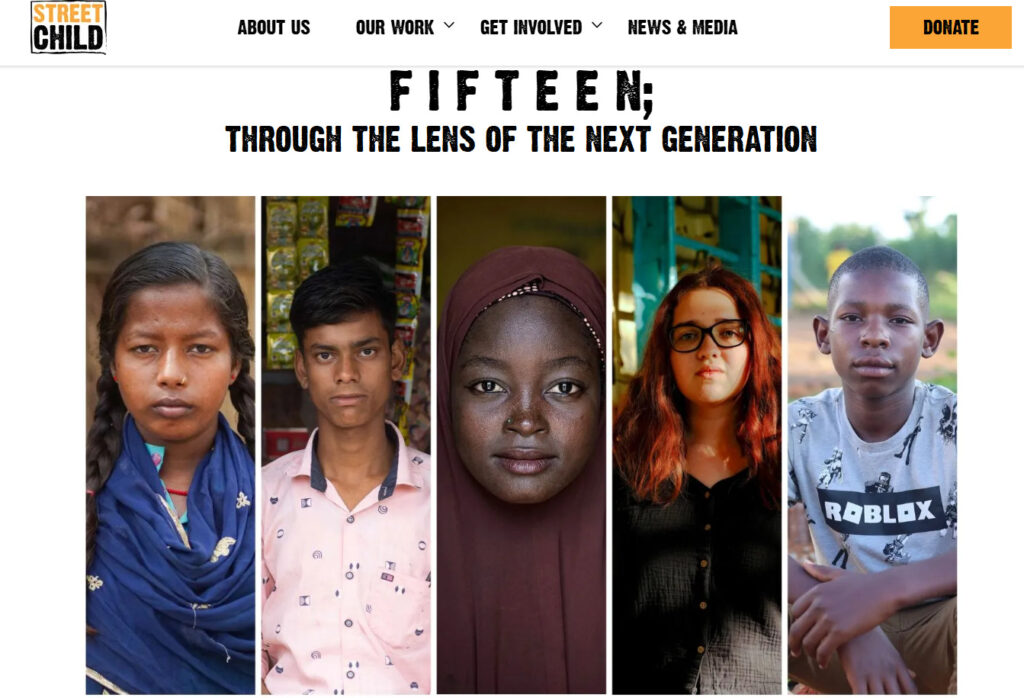
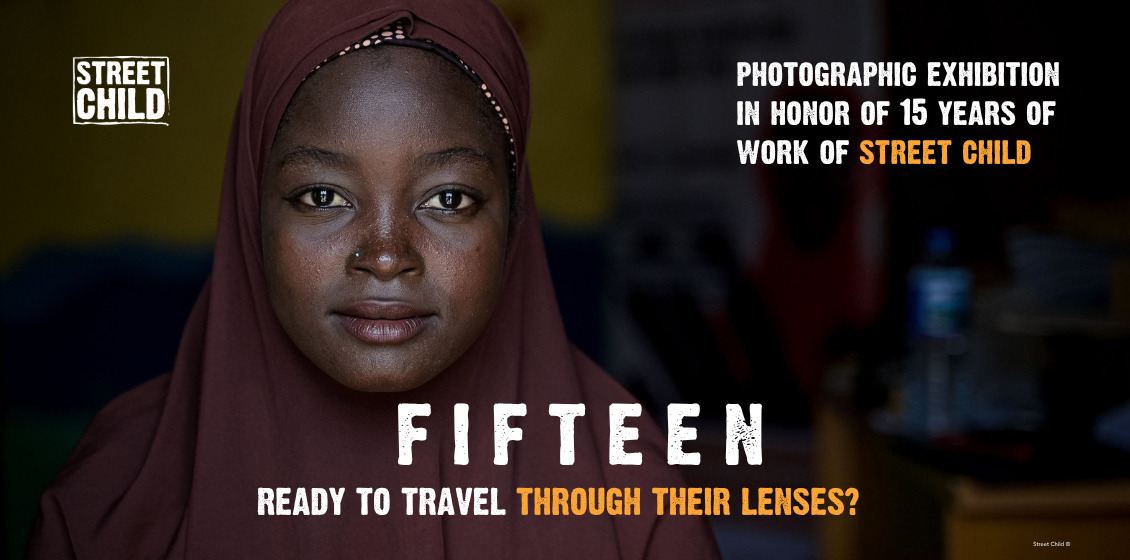
‘FIFTEEN: Through the Lens of the Next Generation’ embodies precisely this spirit of learning and empowerment beyond the classroom. Launched by Street Child to mark its 15th anniversary, the project placed cameras in the hands of 15-year-olds from Bangladesh, Nepal, Nigeria, Uganda, and Ukraine, inviting them to document their own worlds. From conflict zones and refugee camps to remote villages, their photographs capture what it means to be 15 in places where childhood is often shaped by uncertainty and resilience.
Street Child, founded in 2008, is one of the fastest-growing international NGOs working to ensure children are safe, in school, and learning. Present in more than 20 countries, it works to guarantee access to education and child protection in vulnerable communities across Asia, Africa, the Middle East, and Europe. Its teams focus especially on regions where the challenges are greatest and existing humanitarian support is not enough, reaching children who might otherwise be left behind.
What makes Street Child’s approach distinctive is its insistence on working hand in hand with local partners, co-designing solutions that are sustainable, culturally relevant, and aligned with community priorities. In this sense, FIFTEEN is more than an art project, it embodies the very essence of education for sustainable development. The workshops, led by local photographers, gave teenagers not only technical skills but also a platform to express themselves, to tell stories of family, friendship, loss, and hope. Each image is a lesson in resilience, a reminder that empowerment begins when young people are given the tools and trust to define their own narratives.
Human rights are a prerequisite for empowering people to make sustainable choices, and equally important is ensuring participation at every level, ultimately, it is about building genuine communities. And this is precisely what Street Child does. Community is not only the focus of its programs, it is also the foundation of how the organization itself operates. Street Child works as a community and with communities, strengthening and empowering them not only in the countries where programs are delivered but also in the places where its main offices are based across Europe.
Since its foundation, Street Child has built a global network of national entities (including Street Child Spain, Italy, France, Germany, and the Netherlands) that share common values and strive for lasting structural change. Through community empowerment, the organization develops holistic projects that combine educational support, psychosocial assistance, child protection, and livelihood strengthening. Thanks to this approach, Street Child has supported more than 1.5 million children to date.
It is in this same spirit of community that the FIFTEEN exhibition has traveled beyond the countries where the photographs were taken, finding new audiences in London, Barcelona, and Italy. Each stop reflects not only the global reach of the project but also the deep connections Street Child fosters between local realities and international awareness. In London and Barcelona, the exhibition proved to be a remarkable success. In London, home to the headquarters of Street Child’s global network, the exhibition was hosted at the Oxo Gallery in October 2023. It drew strong media coverage and attracted thousands of visitors. Inside, interactive stations invited visitors to donate in support of Street Child’s work or to write a note to their 15-year-old selves, an activity that helped them reconnect with that pivotal stage of life and empathize more deeply with the young photographers behind FIFTEEN.
In Barcelona, where Street Child Spain is based, the exhibition further encouraged a critical understanding of global challenges. From September to December 2024, FIFTEEN was displayed at the Mercè Sala Gallery, located inside Diagonal metro station, one of the city’s busiest transit hubs. The project benefited from both its central location and its free admission policy. In just the first 24 days, 2,322 visitors explored the exhibition, many of whom encountered it spontaneously while commuting.
FIFTEEN was also showcased in Rome, and a selection of its images was presented in Amsterdam as part of an art gallery program. In both cities, the project continued to inspire reflection and spark dialogue, highlighting universal values such as empathy, social justice, equity and respect for human rights.
Humanitarian Aid, Development and the Grand Bargain
Development cooperation, together with education for development and humanitarian aid, can form a powerful combination, a driver of opportunities for vulnerable communities. The FIFTEEN project is a vivid example of how these elements come together to create both awareness and impact.
Yet the humanitarian sector has faced criticism. As Professor Paul B. Spiegel, an expert in humanitarian emergencies, notes, much of the debate that arose in the 1990s centered on the disconnect between emergency relief and long-term development. Humanitarian action often operated under a “short-term and reactive” model, rather than supporting resilience and sustainability. Funding was frequently centralized in large international NGOs, leaving little room for local and national actors, which perpetuated top-down systems and limited empowerment for those closest to crises.In response to these concerns, the Grand Bargain was signed in 2016 by donor countries and major international actors, including UN agencies and the Red Cross. Its goal was to make humanitarian aid more efficient, predictable, and transparent by committing to good donorship, localization, and the transfer of power to local and national organizations. While the agreement has not yet transformed the system as much as expected and progress has been slower than many hoped, Jan Egeland, Secretary General of the Norwegian Refugee Council, reminds us: ‘Progress is slow, but sure.’
Organizations like Street Child demonstrate how local and national actors can take the lead in building sustainable change and resilient communities. This global vision takes concrete form in Spain, where Street Child Spain has firmly aligned its work with the Spanish Law on International Cooperation for Sustainable Development and Global Solidarity, promoted by AECID. Convinced that Education for Sustainable Development and Global Citizenship is essential, it seeks to ensure meaningful citizen engagement through cultivating critical thinking, and on encouraging active involvement in social change. For this reason, Street Child Spain, together with its global network, not only raises awareness but also creates spaces for social participation around the right to education, gender equity, and child protection.
Through projects like FIFTEEN, Street Child demonstrates that education is not confined to classrooms or textbooks, it thrives wherever young people are given tools, trust, and a voice. By combining artistic expression, community collaboration, and global awareness, Street Child empowers children and teenagers to tell their own stories, build resilience, and inspire change. In doing so, the organization embodies the very essence of Sustainable Development Goal 4: a world where every child can learn, grow, and thrive, no matter their circumstances.
Daniela Padilla has a M.Sc. International and Securiy Politics, Catholic University of Lille/ESPOL, France, and is a DDRN Intern