by
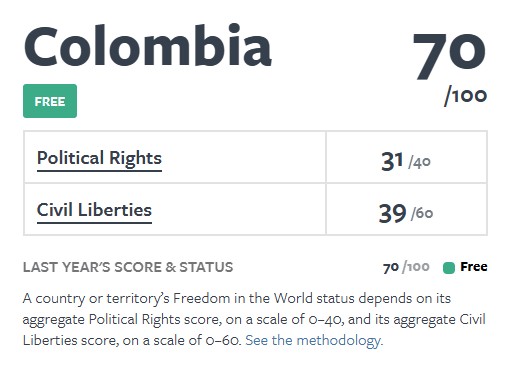
by Most Latin American countries are considered democracies with relatively high political freedom. However, this does not mean they all share the same democratic quality. As the European Parliamentary Research Service highlights, Chile ranks among the “most free and democratic countries,” while Colombia, labeled a “flawed democracy” and “partly free”, does not appear in the top ten. Despite following different historical paths and facing distinct economic and social challenges, both countries share a crucial feature: relatively high levels of civic participation. This engagement has nurtured a multi-sectoral civil society that has driven some of the region’s most impactful organizations, movements, and policy proposals.
In Latin America, civil society often acts as a political counterweight, especially where institutions are fragile, exclusive, or repressive. In Colombia and Chile, confrontations between mobilized citizens and the state have yielded mixed results: some promising, others deeply frustrating. The dominant narrative of “democratic progress” warrants greater scrutiny. Increases in participation and consultative mechanisms do not guarantee a redistribution of power. Political pluralism remains limited by entrenched structures that privilege certain actors, territories, and discourses. In this context, the formal consolidation of democracy conceals an underlying crisis of representation.
This article critically analyzes Colombia and Chile through the lens of development, focusing on the achievements and limits of civil society as a political actor. It asks not only what has changed, but also what continues to resist transformation despite decades of civic mobilization.
Civil Society as a Political Actor
The term civil society is inherently ambiguous but generally refers to the sphere between the state and the private sector. It encompasses a diverse array of organizations—civic, religious, educational, issue-oriented, and non-governmental. For many scholars, like Jan Aart Scholte -an expert in governance challenges- civic activism is a crucial democratic asset. It addresses widening democratic deficits and, particularly in fragile or conflict-ridden states, helps provide essential services and promote reconciliation.
In both Colombia and Chile, civil society has persisted despite limited support, stigmatization, and at times, outright repression. Its impact is evident in two emblematic moments: Colombia’s 2016 peace plebiscite and Chile’s 2019 social uprising. Following the rejection of the 2016 plebiscite, Colombian civil society mobilized beyond the binary “yes”/ “no” divide, demanding renegotiation and continued dialogue with the FARC. This gave rise to 54 peace-related mobilizations (including marches, sit-ins, and artistic actions) and strengthened a culture of social leadership, especially among university students.
In Chile, protests initiated by high school students over fare hikes quickly escalated into mass mobilizations demanding systemic reform. Citizens voiced frustrations over inequality, inadequate public services, and the lingering legacy of dictatorship. One core demand was a new constitution, which led to a national referendum and the subsequent election of a leftist President. However, in both cases, civic momentum has not fully translated into structural change. In Colombia, inequality persists, security remains fragile, and peace negotiations with other armed groups have faltered. In Chile, despite early optimism, the new constitutional draft was ultimately rejected.
Colombian Civil Society: The Invisible Linchpin of Peace Building
Colombian civil society has long advocated for better public policies, transparency, and victims’ rights, especially where state institutions have fallen short. Over time, it has become a diverse and multi-sectoral actor that amplifies the voices of displaced people, women, Afro-Colombian and Indigenous groups, youth, and victims of violence.
According to the independent Colombian journal “Rutas del Conflicto”, during the peace process with the FARC, civil society, particularly human rights organizations, played a central role in pushing for negotiated solutions and post-conflict justice. A landmark example is the opening of Macro-Case 11 by the Special Jurisdiction for Peace (JEP) in July 2022. This case, the result of years of advocacy by women, LGBTQ+ individuals, and rights groups, seeks to investigate sexual and gender-based violence committed by all armed actors.
This success illustrates how civil society can shape institutional agendas when there is political will. Yet, serious challenges persist. Attacks on social leaders, activists, and organizations, especially in remote regions, continue unabated. The presence of armed groups and limited state protection further restrict meaningful participation, while many grassroots struggles remain invisible due to geographic and media marginalization.
Chilean Social Movements: Drivers of Limited Successes
Chile, often lauded for its democratic freedoms, saw those rights curtailed during the 2019 social uprising, when security forces responded to mass protests with widespread repression and human rights violations. Nonetheless, the movement endured and expanded. Sparked by student protests over fare hikes, it soon grew into a national call for deep structural change, targeting inequality, low wages, and weak public services. A central demand was the drafting of a new constitution to replace the one inherited from the Pinochet dictatorship.
In response, a multi-party agreement in 2021 led to the election of a Constitutional Convention with strong civil society participation. The convention achieved notable milestones, such as gender parity and Indigenous representation—an example of inclusive democratic innovation. However, the momentum faltered. In the 2022 national referendum, nearly 62% of voters rejected the proposed constitution. While civic activism helped bring the process into being, it could not secure its approval.
Analysts cite several factors: lack of sustained political support, an aggressive media campaign framing the draft as radical, and societal resistance to reforms such as legal abortion, gender parity, and Indigenous autonomy. More broadly, the defeat exposed a cultural and symbolic divide. Without widespread civic education or a unifying national narrative, even robust mobilization can fail to consolidate change. The Chilean case underscores that beyond institutional access; civil society must also contest the terrain of cultural legitimacy.
Toward Critical Development: Civil Society and Resistance from the Margins
The cases of Colombia and Chile illustrate that a strong, independent civil society is essential to democratic life—but not sufficient for deep, structural transformation. Despite its central role in shaping policies and demanding justice, civil society still operates within institutional frameworks largely controlled by entrenched political and economic elites. Milestones such as Colombia’s Macro-Case 11, Chile’s constitutional process, and the election of reformist leaders reflect significant civic influence. Yet, without sustained protection for activists and mechanisms for real power redistribution, these victories remain fragile.
In both countries, the most transformative forces often emerge from the margins—led by Indigenous women, youth, rural communities, and LGBTQ+ collectives- actors historically excluded from formal politics and dominant narratives. Their resistance has not only exposed systemic failures but also reimagined the boundaries of democratic participation. However, this “resistance from the margins” continues to be under-recognized, underfunded, and vulnerable.
A truly critical approach to development requires shifting the lens away from institutional performance or technocratic benchmarks toward the lived realities and political struggles of those challenging injustice on the ground. It means understanding democracy not just as a system of procedures, but as an ongoing contest over meaning, legitimacy, and inclusion. International cooperation must evolve accordingly. Rather than imposing depoliticized agendas, it must support political and ethical alliances that respect local autonomy and align with grassroots visions of justice. Civil society needs more than financial aid; it needs committed accompaniment across the full spectrum of struggle: from protest to policy, from mobilization to institutional change.
In short, civil society in Colombia and Chile has been a crucial force for denouncing inequality, expanding participation, and envisioning alternative futures. But its capacity to transform the system remains constrained by the very structures it seeks to reform. Recognizing this tension is not a defeatist gesture, it is the starting point for imagining more honest, strategic, and radical forms of civic engagement.
Daniela Padilla has a M.Sc. International and Securiy Politics, Catholic University of Lille/ESPOL, France, and is a DDRN Intern