 by
Why does sexual violence become evidence of societal backwardness when it happens in the Global South, but institutional failure when it happens in the Global North? Why does one rape become a diagnosis of a society, while another becomes a problem within a society? Who gets represented as having a “culture of rape”, and who gets represented as having a “rape scandal”?
Sexual violence is a transnational problem, but the moral narratives surrounding it are not geographically neutral. These are some of the questions I keep coming back to when thinking about the recent case at Cornell University.
A 20-year-old Cornell undergraduate has reported that she was sexually assaulted by seven men at a Chi Phi fraternity house in 2024 after becoming intoxicated and unable to consent. The case has returned to public attention through a civil lawsuit, new evidence presented in that lawsuit, and the reopening of the criminal investigation. Cornell has said that its own Title IX process resulted in suspensions and expulsions, while the lawsuit has challenged the adequacy of the university’s response.
What does it mean when something like this happens in one of the world’s most prestigious universities?
These are institutions that speak constantly about diversity, equality, global citizenship, human rights and social responsibility. So, what happens when the people inside these institutions do not necessarily live up to those values?
These are young men who had access to many of the things our society considers progressive: prestigious education, universities, international environments, opportunities to travel, exposure to different cultures, and the language of equality, diversity and global citizenship.
We often assume that education, privilege and exposure to the world make people more progressive. But having access to progressive ideas is not the same as living by them.
And I don’t think this is only about the individuals involved in the Cornell case. In fact, that is exactly what makes the case interesting to me. Because if we reduce everything to seven “bad men”, we don’t really ask the bigger question.
When does rape become a cultural problem?
When sexual violence happens in the Global South, it can quickly become a story about culture. We talk about patriarchy, religion, education, tradition, poverty and women’s rights. A rape becomes evidence of “their culture”.
But when similar violence happens inside a prestigious institution in the Global North, we are more likely to talk about individual perpetrators, institutional failure or safeguarding. So why does one rape become a diagnosis of a society while another becomes a problem within a society?
This is not an argument for ignoring violence in the Global South. It is a question about the standards we use to interpret it. Who gets represented as having a “culture of rape”? And who gets represented as having a “rape scandal”?
The problem is not that we talk about violence against women in the Global South. The problem begins when that violence is used to construct a moral hierarchy between societies. The Global South becomes the place where women need to be protected, where cultures need to change and where education is needed.
The Global North becomes the place where the same violence is treated as an exception. But what happens when we turn that question back towards ourselves?
The people who were there
The Cornell case also raises questions about the people around the assault. The discussion has not only been about the seven men accused in the lawsuit. Messages from a fraternity group chat have also become part of the case, bringing attention to a wider group of men around the incident.
This is where I started thinking about the research on bystanders.
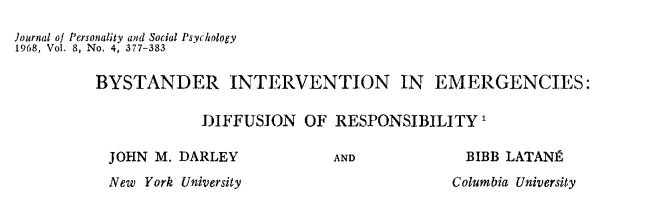
In their 1968 study, Bystander Intervention in Emergencies: Diffusion of Responsibility, John M. Darley and Bibb Latané examined why people do not react in emergency situations. One finding is that the idea of the man as the natural “protector” doesn’t seem to apply as we might expect. Male subjects reported the emergency no faster than females. Female participants also reacted equally fast whether the other bystander was another woman, a man, or even someone with medical training.
There was also another finding that I find even more interesting. The subjects who failed to report the emergency showed few signs of the apathy or indifference thought to characterise “unresponsive bystanders”. Instead, they were concerned about making fools of themselves by overreacting. And this brings me back to the idea of ‘overreacting’. If, in a group of men, protecting a person’s right to their own body and speaking out against rape is seen as something that would make you look like you were overreacting, does this not tell us something about the group’s moral culture?
How often have women been told they are overreacting? And how often are men allowed not to react at all? Research on sexual harassment among medical students in Canada found that students often did not report harassment, even when they knew how and where they could report it. They feared that reporting would not lead to effective action, but also that it could bring personal consequences, damage their relationships with classmates, or make them appear weak. Some students even began to question whether what they had experienced really was sexual harassment. This is important because silence does not always begin with someone explicitly saying, “You are overreacting.” Sometimes it begins with the expectation that you might be.
You might misunderstand what happened. You might make the group uncomfortable. And this is where I think the question of bystanders becomes more complicated.
If women are repeatedly placed in a position where they have to question whether their discomfort is serious enough to speak about, while people around them learn that intervening might make them look dramatic, difficult, or overly sensitive, then silence can become part of the culture of a group. Isn’t that a cultural thing again? Is it only individual cases?
Reduced intervention or accountability?
Darley and Latané showed that the presence of other people can reduce an individual’s feeling of personal responsibility. Their research suggests that inaction can be connected not simply to apathy, but to the way people respond to the presence and behaviour of other people around them.
This matters when we think about a group of men. If speaking up against rape makes someone feel that they are going against the group, while remaining silent keeps them accepted by the group, what becomes more important? Being liked by other men? Or protecting another human being’s right to their own body? At what point does that stop being only an individual moral decision and become a cultural one?
Culture is also created through what people tolerate. Through what they laugh at. Through what they ignore. Through what they don’t want to get involved in. Through what they see and decide is somebody else’s problem. Seven men. Other 50 men in a group chat, aware of what was happening. A wider group. A wider culture.
This is why I find it difficult to look at the Cornell case only as a story about seven individuals. Seven men come from seven different families and backgrounds. They come from schools. They come from universities. They come from a social environment. They are not created in isolation. And this is where the number becomes uncomfortable. If seven men are accused in the case, and dozens of other men were part of the wider group chat and social environment surrounding it, can we really keep calling everything an individual incident?
If we use the term “rape culture” when talking about societies in the Global South, why are we so reluctant to use the same term when we are talking about elite institutions in the Global North?
The most privileged kind of men
This is perhaps the part I find most difficult to understand. What does it mean when the men involved are the kind of men that our society considers privileged? Men who have had access to some of the best universities. Men who have been educated in institutions that promote global equality, diversity, leadership and human rights. Men who have had opportunities to travel, encounter different cultures and broaden their horizons. Men who are being prepared to take important roles in society, in business, leadership, development and other areas of influence.
What are we saying when we call these environments progressive? And what happens when people who have had access to all this still participate in violence, enable violence or fail to challenge it? Does education automatically produce morality? Does international exposure automatically create empathy? I don’t think we can assume that it does. And this is where I also think about the Epstein files. The Epstein case has made something very visible: the networks surrounding wealth, power, influence and elite social circles. What interests me here is the same question.
How can we continue to imagine that education, wealth, prestige and access to the “right” institutions automatically place people on the progressive side of history?
What do we expect from the people we educate?
Perhaps whe institutions that teach students to think critically, to understand different societies, to question inequality and to become future leaders. We associate education with awareness. We associate international exposure with openness. We associate privilege with opportunity. But none of these things automatically produce a different kind of person. Maybe that is something we need to be more honest about.
A person can travel the world and still carry deeply narrow ideas about women. A person can study at an elite university and still participate in a group where another person’s boundaries are treated as less important than belonging to the group. A person can know the language of equality without necessarily practising it. And perhaps this is where the conversation about sexual violence needs to go next. Not only towards asking how we punish individuals after violence has happened, but towards asking what kind of environments we are creating before it happens. What do young men learn from the people around them? What behaviour is challenged, and what behaviour is laughed off? What happens when someone speaks up? What happens when nobody does?
These questions do not belong only to universities in the Global North. They belong everywhere. But perhaps the Global North also needs to become more comfortable being the subject of these questions, rather than always being the one asking them. Because if we genuinely believe that culture shapes violence, then we cannot only look for culture somewhere else. We have to be willing to look at our own institutions, our own groups and our own definition of what it means to be progressive.
And maybe that is where the conversation should begin.
Eva Karakaxa is a master’s student in African studies, University of Copenhagen, and a DDRN intern