by
by The Arctic region has increasingly gained prominence as an area of global strategic, environmental, and socio-economic importance. Given its already fragile ecosystems, diverse Indigenous cultures, minerals, and other valuable, unexploited natural resources, the Arctic has become a central focus of international governance efforts. Arctic policy encompasses the strategies, agreements, and institutional frameworks developed by the eight Arctic states, namely Denmark, Norway, Sweden, Finland, Iceland, Canada, Russia, and the United States, in collaboration with international organizations and non-governmental actors, to regulate and manage the region.
Throughout the past century, the Arctic has experienced progressive landmark treaties, national policy strategies that acted as various environmental awareness policies, scientific assessments for further conservation, and advocacy reports that have influenced the evolution of Arctic governance and the bonding role of the region to serve as a point of convergence among various great powers as well. These documents reflect shifting global priorities, including territorial administration, resource utilization, environmental preservation, and the recognition of Indigenous rights. This paper examines key policy milestones from early twentieth-century agreements to contemporary cooperative frameworks. Particular attention is given to three interconnected themes that have shaped Arctic governance: environmental protection, Indigenous rights, and economic development. Collectively, these themes demonstrate the transformation of the Arctic from a geographically remote and politically contested region into an important arena for international cooperation and sustainable governance.
Early Foundations of the Arctic Policy
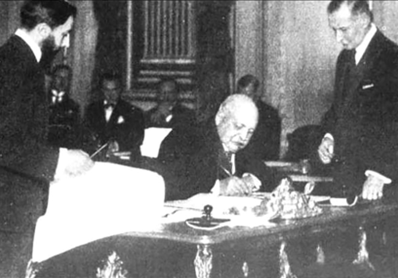
The Svalbard Treaty should be regarded as one of the main attempts to establish Arctic policies, as this treaty not only changed the perception of various actors over the Svalbard region, which previously was regarded as a no man’s land, but it also attributed to Norway full control of the region with the condition of preserving the region as it is relevant for the Arctic. Initially, the Svalbard Treaty was signed by 8 most relevant countries in the region and outside of it at the given time, which include: the USA, the UK, India, Denmark, France, Italy, Japan, Norway, the Netherlands, and Sweden. Relevant articles that enshrine the extent to which Norway is entitled to ownership, to engage in different activities, and what kind of responsibilities the state should bear throughout their proceedings, under the quality of Norway being the inheritor of these lands, are stipulated in articles 2, 3, 4, 5, 6, 7, and 8. The article 9 and 10 can be regarded as cornerstones for turning the region into an economic, non-militarized, and environmentally protected zone meant to be accessible, firstly to all great and regional actors for cooperative purposes and then for others who would be interested in being involved. The article 10 also introduced the possibility for Russia to join at any given time after the moment of ratification, proving flexibility and integration to multilateral commitments from the signatory majority of that time.
Later, in 1970, the Arctic witnessed further individual commitments meant to protect the Arctic. The Arctic Waters Pollution Prevention Act represents a foundational instrument in the development of modern Arctic governance and has significantly influenced subsequent regional cooperation mechanisms, including agreements negotiated under the Arctic Council. By establishing stringent pollution prevention and regulation standards, and other norms that enforce a direct liability over the subjects to which these provisions were applicable, the Act anticipated key principles later embedded in Arctic Council frameworks, particularly the emphasis on environmental protection, emergency response coordination, and sustainable maritime activity (https://laws-lois.justice.gc.ca/eng/acts/a-12/fulltext.html).
The Act’s precautionary regulatory approach contributed to the normative development of cooperative environmental governance reflected in the 2011 Arctic Council Agreement on Cooperation on Aeronautical and Maritime Search and Rescue, the 2013 Agreement on Marine Oil Pollution Preparedness and Response, and the 2017 Agreement on Enhancing International Arctic Scientific Cooperation. These agreements collectively reinforce state responsibility for multilateral engagement and commitment, which also included environmental risk management and cross-border emergency coordination, all of which align with the regulatory philosophy established by the Canadian legislation.
Moreover, the Act helped legitimize expanded coastal state jurisdiction in ice-covered waters, a principle later codified in international law and reinforced through Arctic Council policy coordination. As a result, the legislation served as an early model demonstrating how national environmental regulation could shape regional governance norms and facilitate multilateral cooperation in the Arctic.
By the late 1980s, shifting geopolitical conditions created new opportunities for Arctic cooperation, particularly on transboundary environmental issues. A decisive turning point occurred in 1987 when Soviet leader Mikhail Gorbachev delivered the Murmansk Speech, proposing the Arctic as a zone of peace and advocating expanded cooperation in environmental protection and scientific research. This initiative directly encouraged Finland to promote multilateral environmental governance in the region.
These efforts culminated in the 1991 Rovaniemi Declaration and the establishment of the Arctic Environmental Protection Strategy (AEPS), adopted by the eight Arctic states. Although non-binding, the AEPS created the first structured framework for circumpolar environmental cooperation. It identified key environmental threats, emphasized shared responsibility for ecosystem protection, and formally incorporated Indigenous participation through observer and later Permanent Participant roles. The creation of specialized working groups institutionalized scientific monitoring and policy coordination, establishing operational mechanisms for regional governance.
The AEPS provided both the political momentum and institutional architecture necessary for the creation of the Arctic Council in 1996 through the Ottawa Declaration. Building on AEPS structures, the Council expanded cooperation beyond environmental protection to include sustainable development, resource management, and Indigenous knowledge integration. Collectively, these initiatives transformed ad hoc diplomatic engagement into a formalized governance system, positioning the Arctic Council as the central forum for multilateral Arctic cooperation.
Growing geopolitical tensions have strained Arctic cooperation. Following Russia’s 2022 invasion of Ukraine, collaboration within the Arctic Council was largely suspended, weakening cooperation in all sectors, including environmental and Indigenous governance mechanisms that previously defined Arctic stability. Although limited technical cooperation has resumed, diplomatic coordination remains restricted, while increasing military activity threatens long-standing environmental monitoring and emergency response frameworks.
Recent developments within the Kingdom of Denmark and Greenland demonstrate both risks and opportunities. Denmark’s 2025 Arctic Council chairmanship stresses international law and cooperative governance, while Greenland’s updated foreign and security strategy seeks stronger Indigenous and regional representation in Arctic decision-making.
Maintaining Arctic cooperation is therefore essential. Preserving multilateral governance safeguards fragile ecosystems, supports Indigenous communities, and prevents geopolitical escalation in a region critical to global climate stability.
The weakening or potential collapse of the Arctic Council would directly affect SDGs 13, 14, 15, and 17, undermining the scientific cooperation and coordination over a wide range of activities, including climate monitoring and biodiversity protection. The Council supports projects funded by millions annually, including over 40 initiatives financed by Canada alone. The European Union has also committed significant resources, including €15 million for Arctic observation systems and broader climate research programs worth €93.5 billion.
The future effectiveness of European climate and sustainability policies may therefore depend on whether multilateral Arctic governance can adapt to geopolitical tensions while maintaining scientific and environmental collaboration. Assessing the opinion and vision of field experts is imperative to analyze how IGOs and other high-level officials should steer their policies for preventing isolation and drawbacks in the related domains of activity that have the Arctic region as the core subject of political, social, cultural, environmental, and economic interest.
Florin-Madalin Nicu is a student of the BACHELOR’S PROGRAM OF INTERNATIONAL RELATIONS at Eurasian National University “L.N. Gumilyov”, Kazakhstan