 by
by This piece is my reflection on my visit to the magical forest in the Kendeng Mountains, home to the Baduy people, an indigenous community in Indonesia. Here, life unfolds in harmony with nature guided by a set of customary rules (pikukuh) passed down through generations. Walking through lush hills and hidden trails, I witnessed a way of life where humans and nature coexist in perfect balance, a journey that feels both timeless and otherworldly.
As you read on, you might be asking, “Who are the Baduy, and where do they live?”
Discovering the Baduy People
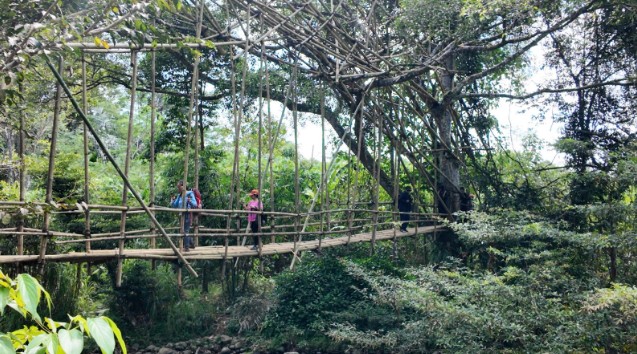
I had the chance to visit the Baduy People in 2025, in a village called Cibeo, located in Banten, the westernmost part of the island of Java in Indonesia. The Baduy area is within a few hours’ travel from Jakarta. The journey took around two hours from Tanah Abang Station to Rangkasbitung Station followed by a two-hour minivan ride to reach the final basecamp. From there, it was a seven hour trek to reach the village.
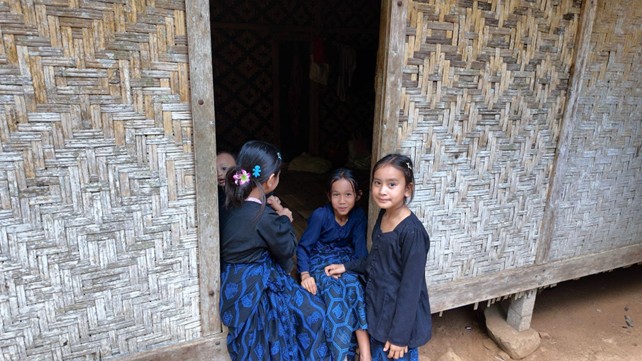
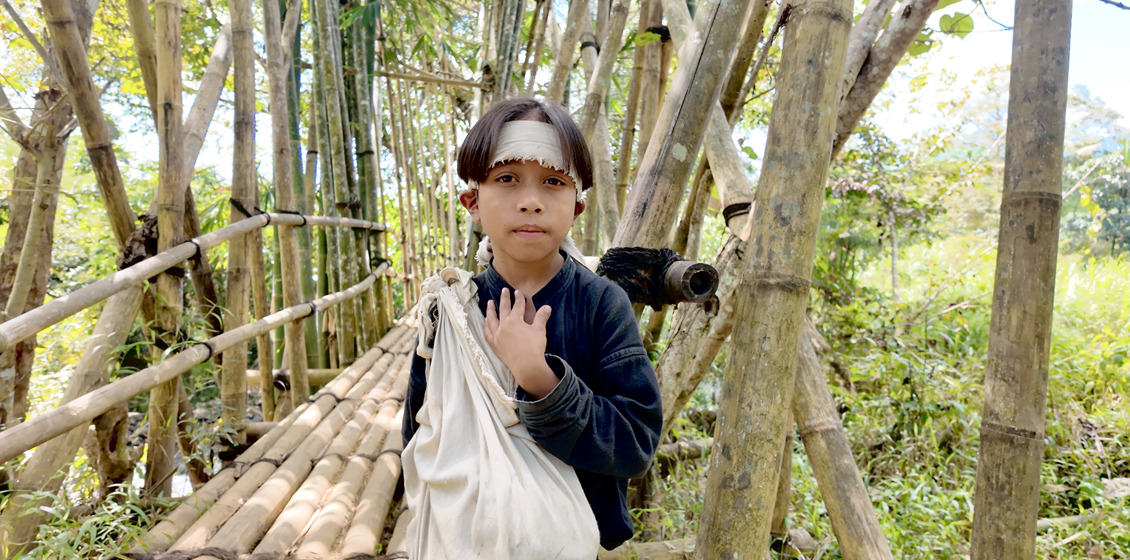
The Baduy community is divided into Outer and Inner Baduy. For outsiders unfamiliar with them, it can be a bit difficult to distinguish between the two. However, there is a striking difference, namely their clothing color. The Outer Baduy typically wear black or dark blue clothing, while the Inner Baduy wear white. The white clothing of the Inner Baduy symbolizes purity and reflects their adherence to their ancestral traditions. This commitment is part of a broader philosophy that shapes their daily life.
The Baduy philosophy says, “Lojor heunteu beunang dipotong, pèndèk heunteu beunang disambung.” In other words, what is long must not be cut, and what is short must not be joined. This teaching emphasizes respect for nature and the resources it provides: everything that exists has its purpose and should be preserved as it is, since nature already meets human needs without being altered for mere desires.
They allow researchers or visitors to document their daily life. In contrast, Inner Baduy is stricter, prohibiting the use of any technology and cutting off internet access. Outsiders are only allowed to stay in Inner Baduy for one day. If they wish to conduct further research, community representatives will walk from their homes and meet the researchers at the basecamp.
I still remember how excited I was when taking photos of the outer Baduy area, until I reached the barrier bridge and was reminded to turn off the devices. From that moment, the experience shifted and while staying in Inner Baduy, I was not allowed to take any pictures or record anything, so the trip could focus on reconnecting with the community and nature. I focused on remembering the moments, sketching the layout of the village, and being fully present.
Baduy Daily Life
According to their custom, the Baduy community is led by a leader called pu’un, who must be from the Inner Baduy community. They are the ones who establish laws and all matters related to their customs. Each Inner Baduy group has a Puun who leads their group. The pu’un is assisted by a Jaro (head of the Kapuunan) who manages the day-to-day government affairs. Each pu’un in Inner Baduy has different authorities; in Cibeo Village, where I stayed, the pu’un was responsible for Baduy community services, social affairs, and other regional matters. The Cibeo community also handled governance, agriculture, and communication with outsiders.
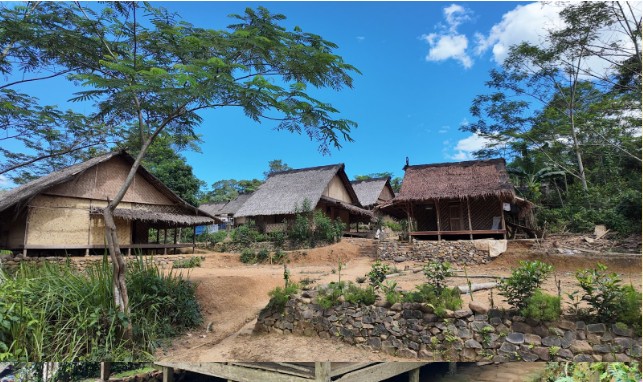
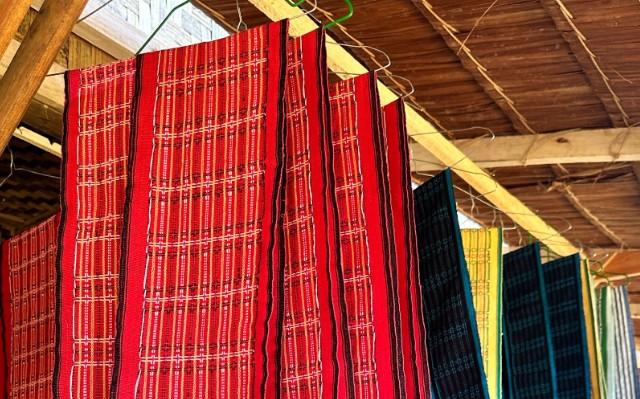
Agriculture is the primary livelihood of the Baduy. In general, the Baduy people make their living by farming, weaving, and trading, with no specific gender division, as both women and men perform the same tasks in the household. Their houses are constructed from bamboo, wood, and palm leaves and thatch are commonly used for roofing. The house typically lacks furniture such as tables, chairs, or beds.
For farming, they do not use chemical pesticides or fertilizers and only harvest once a year, in order to treat the environment gently. They also do not practice animal husbandry such as raising cows or other four-footed animals. The Baduy people have rice production on dry hillsides (huma), and use ecological pest control techniques. Their agricultural practices emphasize ecological balance and traditional knowledge, as highlighted in a study on Baduy ecological farming. Their methods of preserving the harvest provide an effective and sustainable approach to providing solutions for sustainable food.
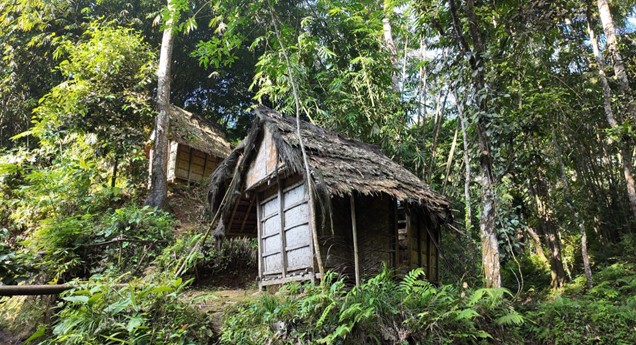
To manage their harvest effectively and maintain a reliable food supply, they build a small bamboo house called leuit, located outside the main village. Leuit serves as a granary to store rice and its surplus until it is needed, the rice often being saved for up to a century without spoilage. I see the leuit not only as storage but as a form of disaster risk management: as they explained, if a fire were to occur, the leuit ensures that the community still has a secure supply of rice.
Living in Baduy slowly shaped my daily experience. They do not have bathrooms since all water-related activities take place in the river. Women and men have separate areas, as does the pu’un. At first, I felt a sense of awkwardness, but that feeling gradually disappeared as the Baduy women welcomed me warmly, showing me how to use natural ingredients for bathing and including me in their routines. Their kindness and openness made me feel part of the community, and I began to enjoy the refreshing coolness of the water.
I remember being given a plant stem, and when I asked about it, they simply explained that the stem was called honje and that it had to be crushed to release its fragrance. It was not until I got home that I learned more about honje. The stem of honje (Red Torch Ginger) is used as a soap substitute, producing natural bubbles. These natural materials are renewable, non-toxic, and biodegradable. This close relationship with natural resources extends to their approach to health. As one elder, whom we called “Father,” explained, the average life expectancy in the Baduy community is around 80 to 90 years. Even when someone falls ill, they rely on medicinal plants found throughout the village.
Rethinking Tourism in Baduy
The Baduy reject the concept of “tourism” and instead promote a new concept called Saba Budaya or communal bounding, as stipulated in Kanekes Village Law No. 1/2007 on Saba Budaya and the protection of Kanekes cultural communities. Over the past few years, Baduy has attracted a number of visitors both local and international. This interest has sparked debate about how far visitors’ habits and behavior may influence and potentially disrupt the Baduy way of life. While tourism brings cultural exchange and economic benefits, it also brings challenges. Traditions that were originally privately owned by the community have increasingly become public spectacles and this exposure has even prompted the Baduy leaders to raise their concerns with the Indonesian government.
Even though Saba Budaya was designed with strict guidelines, challenges still arise. Visitors sometimes fail to respect the rules, leaving behind trash, entering sacred areas, or taking pictures without permission, which can disrupt the community’s delicate balance and long-held traditions. Since September 2025, foreign tourists are restricted to visit several places as sacred areas must remain protected. While access to the inner Baduy areas is restricted, foreign tourists are still welcome to visit the Outer Baduy.
This is not the first time the Baduy have adjusted their rules regarding visitors. In 2020, during the Covid-19 pandemic, the community implemented strict measures and successfully reported zero cases. Their unwavering discipline and strong sense of solidarity demonstrated their remarkable ability to adapt to external challenges while fiercely protecting their unique way of life.
Not Left Behind, Simply Different
On social media, I often see the Baduy people in Jakarta selling their natural honey. At the same time, they are sometimes mocked for being barefoot or for their appearance. Recently, a 15-year-old Baduy teenager selling honey in Central Jakarta, was violently robbed. The attack left him not only financially harmed but also traumatized. The suspect is still being pursued by the police. This incident shows that the challenges the Baduy face go beyond social ridicule. Navigating unfamiliar urban spaces can put them in real danger.
The Baduy are often misunderstood as a community “left behind” by modern life, but my experience gave me a very different perspective. Having spent time with them, I can say this with certainty. They deserve respect and should not be seen as inferior or weak. Their way of living is far more harmonious and truly sustainable than that of many modern communities who talk about sustainability but struggle to put it into practice. While much of society is still debating the best way to implement a sustainable lifestyle, for the Baduy, it is not a theory. They realize that no matter how advanced life becomes, humans will always depend on nature. Destroying it puts humanity at risk.
Visiting Baduy gave me an unforgettable experience: slowing down, respecting boundaries, and leaving with values rather than content. They are not left behind. They are aware that the world is changing, but they consciously reject certain forms of modernization to protect the system passed down by their ancestors.
Rostya Septiana Putri is a MSc in Sustainable Development, Norwegian University of Science and Technology (NTNU), with a strong focus on the Environmental, Social, and Governance (ESG) sector, founder of Green Jobs Indonesia, and DDRN Intern.