 by
by By October 2025, according to OCHA, only 23% of the global humanitarian funding required for the previous year had been met. Behind this percentage lies a stark reality: millions of people affected by conflict, displacement, and climate-related disasters received less support than planned, while frontline responders struggled to stretch increasingly limited resources. The shortfall reinforces a pressing question: who has access to funding, who controls it, and who ultimately decides how it is used?
These tensions sit at the heart of contemporary international development. Grounded in principles of solidarity and shared responsibility (articulated through agendas such as the Sustainable Development Goals under the United Nations) development is framed not merely as technical assistance, but as a collective commitment to building more inclusive, equitable, and sustainable societies. Yet the language of partnership and multilateralism often contrasts with operational realities. International cooperation operates through complex systems of bilateral donors, multilateral institutions, development banks, civil society organizations and non-governmental organizations, where financial control and decision-making frequently remain concentrated in donor countries.
Forms of cooperation shape these power dynamics. Many developing countries have historically preferred multilateral assistance, perceiving it as less directly tied to national security or commercial interests than bilateral aid. International aid has therefore been conceived not only as a mechanism for resource transfer, but as a means of addressing structural inequalities within the global system. This broader ambition, however, intensifies debates about ownership, accountability, and authority in development cooperation.
Localization as a Structural Shift in Development Practice
It is within this structural tension, between normative commitments to solidarity and the realities of asymmetrical control, that localization has emerged as one of the most significant contemporary reform agendas. By seeking to rebalance resources, authority, and decision-making toward local actors in the Global South, localization challenges operational practices and the political economy of international cooperation itself.
The agenda gained momentum at the World Humanitarian Summit and through the Grand Bargain, which committed states and organizations to increase direct support to local and national actors and strengthen their institutional capacity. At its core, localization shifts development practice from externally designed, donor-driven interventions toward approaches grounded in local ownership, contextual knowledge, and community leadership — often summarized as “as local as possible, as international as necessary.”
Local and national NGOs are widely recognized as crucial actors in humanitarian and development action. They possess contextual expertise, cultural legitimacy, and sustained community presence, often remaining long after international agencies withdraw. In many crises, they serve as first responders, maintaining access where international actors face security or logistical constraints. Consequently, NGOs play a distinctive role, emphasizing participation, civil society strengthening, and empowerment — enabling marginalized groups to articulate and defend their interests.
However, participation has often remained consultative rather than transformative. In many cases, local actors are invited to contribute but not to lead. Localization seeks to move beyond inclusion toward ownership: the capacity to define priorities, shape strategies, and control resources.
Hence, localization can be understood in two ways. On one level, it represents an internal reform of the development architecture, improving efficiency and accountability by leveraging local knowledge in complex contexts. On a deeper level, it signals a normative shift, reimagining cooperation not merely as resource transfer but as a redistribution of authority and partnership. In this sense, localization challenges paternalistic tendencies and seeks to align practice with principles of solidarity and self-determination articulated in the UN framework.
Putting Localization into Action
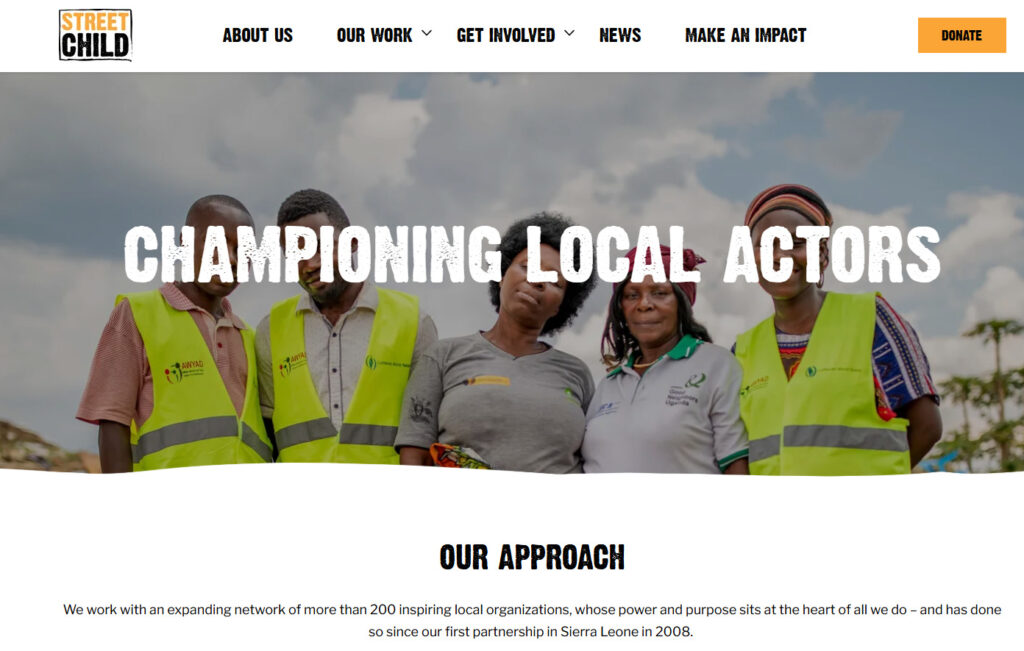
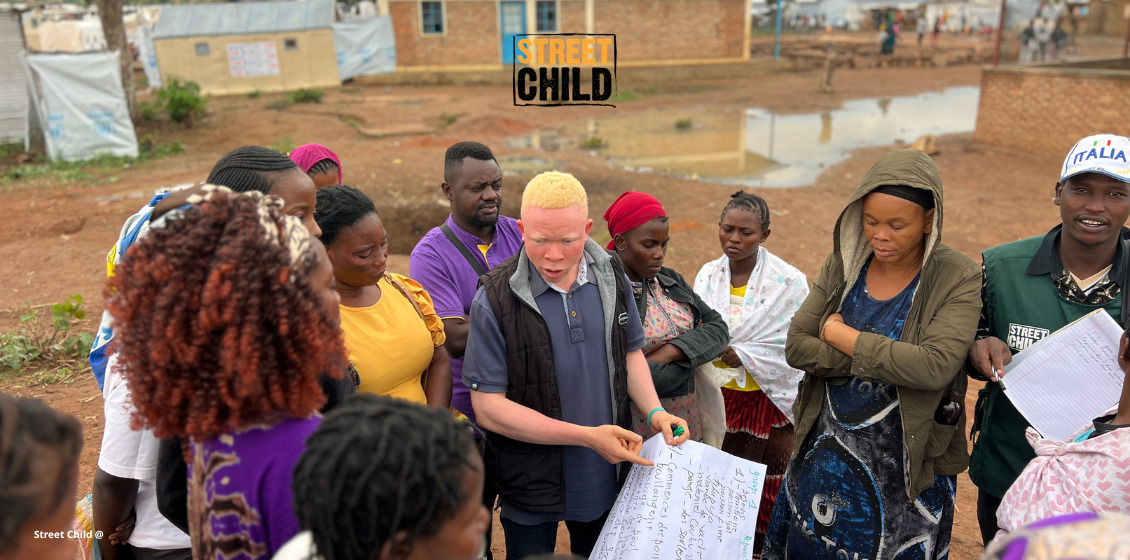
As part of this process of strengthening local political agency, Street Child provides a clear example of how localization moves from concept to practice. Its approach is defined by working alongside local partners to co-design solutions grounded in community priorities rather than externally imposed templates. Through initiatives such as its flagship project, Elevating Local Leadership in Emergencies (ELLIE), Street Child engages local actors as full partners (not merely implementers) supporting them to lead programmes, access resources, and assume roles within broader humanitarian coordination structures. Partnerships are structured not only around delivery but around institutional strengthening, including support for funding access, financial and safeguarding systems, monitoring frameworks and long-term organizational autonomy.
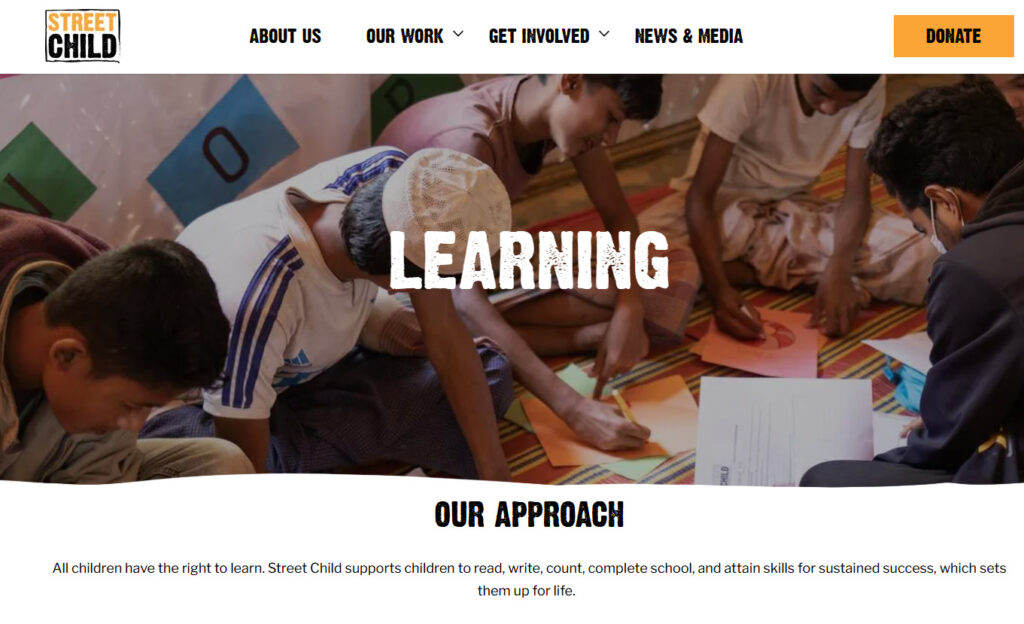
A central element of this model is the intentional transfer of technical expertise. Approaches such as Teaching at the Right Level (TaRL) and Accelerated Learning are embedded within local NGOs, enabling independent, high-quality delivery. Increasingly, this strategy incorporates a gender-responsive lens, recognizing women as educators, leaders, and agents of intergenerational transformation. By localizing both expertise and leadership, including women’s leadership, the aim is not only effectiveness but structural rebalancing.
This approach is particularly visible in Uganda, where Street Child advanced localization within programmes supported by Education Cannot Wait (ECW), the United Nations’ global billion-dollar fund for education in emergencies and protracted crises. Under ECW’s Multi-Year Resilience Programme (MYRP) and First Emergency Response (FER) frameworks, Street Child co-established a dedicated Localization Unit to create fairer access to funding for national NGOs. By enabling them to compete equitably with international organizations, a significant share of programme funding flowed directly to national partners, strengthening locally led education responses and shifting decision-making closer to affected communities.
In South Sudan, a similar approach has been taken through the Education For All South Sudan (EFASS) programme and Street Child’s Partnership Support Unit. Here, local actors are supported to lead emergency education interventions, with hands-on guidance to manage resources, secure funding, and build robust organisational systems. This support strengthens local ownership while also embedding accountability, transparency and operational resilience. The programme actively promotes women’s leadership in schools and communities, recognizing the long-term impact of gender-equitable education on society.
As a result, by prioritizing local expertise and leadership, Street Child demonstrates that effective interventions are rooted in the knowledge, networks, and agency of those closest to affected communities. Its model illustrates that localization is not merely a technical adjustment but a practical effort to redistribute authority and embed sustainable capacity within local institutions. In doing so, Street Child translates the normative ambitions of localization into tangible practice, offering an example of how international development can more coherently align global objectives with locally driven leadership.
Challenges Ahead
Despite its growing prominence, localization remains the subject of ongoing discussion. Financial regulations, risk-averse donor practices, and entrenched hierarchies continue to shape development architecture. Meaningful localization therefore requires more than funding targets; it demands a sustained reconfiguration of relationships, incentives and accountability. It calls for trust, reciprocity, and a willingness among international actors to relinquish control that has long defined the system.
If international development is to remain faithful to its commitments to solidarity, self-determination, and shared responsibility, localization must move beyond rhetoric. It must continue evolving as a practical effort to reshape partnerships, embed authority, and empower communities and institutions closest to crises.
At its core, localization is about centering the knowledge, expertise, and agency of local actors. Communities bring unique insights, skills and solutions that are essential for sustainable, responsive, and effective interventions. Flexible funding, equitable collaboration, and investment in local capacities unlock these contributions, ensuring that programs are not only efficient but also contextually grounded.
Street Child’s work in Uganda, South Sudan, and other contexts demonstrates this principle in action. By supporting local actors to lead programs, access resources and participate in decision-making, it shows that empowered communities are more resilient, better able to respond to crises, and capable of sustaining long-term outcomes. The journey toward genuinely equitable, locally led humanitarian and development systems is arduous, but it is both necessary and possible, and it reminds us that the most effective solutions arise from those closest to the challenges, not imposed from afar.
Daniela Padilla has a M.Sc. International and Securiy Politics, Catholic University of Lille/ESPOL, France, and is a DDRN Intern