 by
by History can be construed for political purposes, often to the detriment of marginalised groups who find themselves underrepresented in the mainstream narrative. The way history is written also determines which lessons are taken from past events. A politicised historiography risks obscuring the real mechanisms driving history, leading to an inability to act efficiently when old socio-political and economic problems arise in a new form.
One such example is the way the struggle of Black Loyalists—individuals of African descent who fought for the British during the American Revolution (1775–1783)—is overlooked in the dominant historical narrative in the United States.
The American Revolutionary War is often framed as a conflict between freedom and oppression, with the American rebels on the side of freedom—“all men are created equal”, as is stated in the Declaration of Independence issued in 1776.
Such freedom was not the experience for the 20% of the population who were enslaved. Historian Edmund Morgan, in American Slavery, American Freedom, named this contradiction the American Paradox. From that perspective, the equality of the US founders—men like George Washington—and people who looked like them depended on and was sustained by the inequality of their African slaves.
Further complicating matters, Lord Dunmore, the British Governor of Virginia, in 1775 issued a proclamation granting freedom to slaves who abandoned their masters and fought against them. Although Dunmore’s Proclamation only applied to Virginia, some estimates claim that up to 100,000 slaves from all over what was to become the United States escaped to British lines.
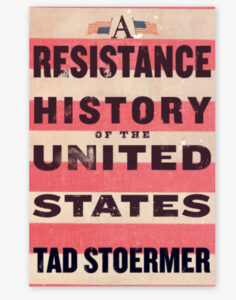
For Dr Tad Stoermer, External Lecturer at the Center for American Studies at the University of Southern Denmark (SDU) and Lecturer at Johns Hopkins University, the story of the Black Loyalists highlights the way history can get skewed to serve political aims. In his upcoming book, A Resistance History of the United States, the Black Loyalists are one of the case studies used to show US history as shaped by struggle. Not against outsiders such as the British, but through confrontation with the very system established after the American Revolution.
A Resistance History of the United States
According to Dr Stoermer, the master narrative of the US founding is that the state and the institutions the revolution created—the US Constitution, separation of powers, the Electoral College, etc.—are inherently good because they were founded on principles of democracy and equality; “all men are created equal”.
Both sides of the political spectrum share this view, although articulated in different ways. The conservative reading is based on the idea of Originalism, meaning that legal texts, including the Constitution, should be interpreted as they were understood at the time of adoption. For instance, the conservative-dominated US Supreme Court, in 2022, overturned Roe v. Wade, a previous decision recognising the right to abortion in all 50 states, arguing that in the original text of the Constitution, there is no mention of abortion rights. Instead, the issue should be left to the states. This perspective makes extending rights to previously excluded social groups an arduous task.
Crucially, liberal forces in the US also end up reproducing a version of Originalism. The progressive movement, even while in favour of more expansive rights and protections for minorities, often assumes, like its conservative counterpart, that the state founded in 1776 is, at its core, just. The shortcomings of the system, in this narrative, are due to malign individuals and movements corrupting the original institutions and their purpose. By accepting this “Patriot Myth”, both sides have “created a ceiling on all possible opposition”, Dr Stoermer contends.
This conclusion is not new. In An Economic Interpretation of the Constitution of the United States, the historian Charles Beard argued in 1913 that it is possible to view the US political system as an arrangement designed from the outset to protect the property rights of a rich minority by preventing majority rule and constraining the power of the state legislature from limiting gains on capital through checks and balances.
“So if the institutions are failing, if they are captured, if they in fact are operating against the rights of the people, you cannot escalate outside of them because they are inherently legitimate … All opposition has to get channelled through these pre-ordained, accepted ends. And if they don’t work, then you just have to live with the results. That is not what is shown as having achieved gains in US history,” Dr Stoermer continues.
How have gains been achieved? The argument in A Resistance History of the United States is twofold. Firstly, the book posits that most of the progress in protecting human rights in the US over time has come from resistance to the establishment, not as a result of the establishment’s inherent morality. The experience of the Black Loyalists illustrates that this tension existed from the start.
Secondly, that resistance towards what Dr Stoermer calls abusive authority is a gradual process that begins with protest and legal opposition when a government misuses its authority, escalating if the system fails to correct the injustice. Due to blocking forces within the state, such resistance takes time, and battles over particular rights—abortion, for example—may have to be fought over and over.
The story of the Black Loyalists is also instructive. To avoid re-enslavement, they were evacuated to other British colonies in North America as defeat in the Revolutionary War became inevitable. About 800 arrived in the Bahamas, where they had to struggle to maintain their freedom.
Black Loyalists in the Bahamas
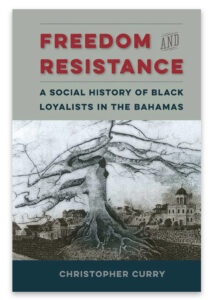
“My main character, for example, Prince Williams, is enslaved. He’s freed by certificate for his military service in the British Army, and then he comes to the Bahamas, and somehow he shows up in a newspaper ad as a runaway [slave]. He has to fight for his freedom a second time,” Dr Christopher Curry, Associate Professor of History at the University of The Bahamas and author of Freedom and Resistance: A Social History of Black Loyalists in the Bahamas, told DDRN.
Prior to the American Revolution, the Bahamas were largely underdeveloped. The settlement of both Black and White Loyalists had a transformative effect. By 1790, several new islands were settled, the colony’s white population doubled (3,500), and the black population tripled (6,500).
Freedom and Resistance shows how Black Loyalists had to adapt their politics and actions depending on their local circumstances—sometimes violently confronting racial inequalities, sometimes seeking out white patronage for personal advancement, acquiring land and even owning slaves. Black Loyalists also established social and religious institutions, such as churches and schools. In fact, we know that Prince Williams eventually regains his freedom because he is listed as an owner of the property that will eventually become Bethel Baptist Church, which still exists today.
Moreover, the Black Loyalists contributed to the political development of the Bahamas. They understood the rights afforded to them as free subjects of the British Empire, using them to protect their freedom and laying the groundwork for deeper inclusivity. “There was a franchise act passed in 1833, allowing persons of colour to get elected to the House of Assembly. The decade-long struggle for that political right would not have happened if you did not have the Black Loyalists, who began the foundational work in the 1780s and 1790s, agitating for their rights in courts, demanding that they be considered free persons,” Dr Curry says.
As in the United States, the Black Loyalists have traditionally been excluded from the mainstream historical narrative in the Bahamas, which instead glorifies the White Loyalists. Dr Curry explains: “Since the White Loyalists were the ones who had access to power, wealth and most of the land, monuments and so on were built for them. Their story got told because they had the power and the opportunities to do that.”
Today, a lot of work is done to highlight the Black Loyalists’ role in Bahamian history. For instance, with the help of Dr Curry and other scholars from the University of The Bahamas, the country revised its history textbook for high schools in 2025. The new textbook incorporates recent scholarship on Bahamian history, with a particular focus on the Black Loyalists and other previously overlooked groups.
Freedom: A Tenuous Process
Above all else, Freedom and Resistance emphasises just how fragile freedom can be. In doing so, Dr Curry says, “it opens an interesting Pandora’s box to thinking about what the American Revolution actually achieved, and how freedom is often tenuous and murky when it crosses transnational borders”.
In the case of the United States, a method for going beyond the Patriot Myth could entail something similar: “If you can engage people in a conversation about what the American Revolution was really all about, you can detach that discussion from an appreciation that this nation-state [the US] is the best way to support those [liberal] principles,” Dr Stoermer says.
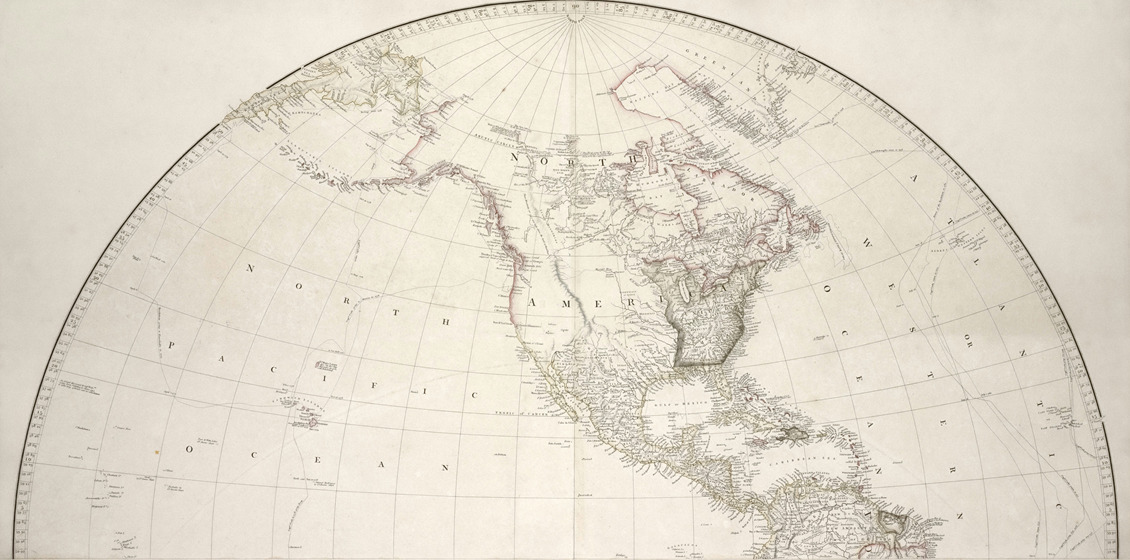
The American Revolution was, as the name suggests, a continental—even transatlantic—event, with battles fought in what is now the United States, Canada, several Caribbean countries, Portugal, Gibraltar, Spain, Guatemala, France, Ireland, and off the coast of North Africa. Like other major revolutions, it had many causes and outcomes, the political systems in the Bahamas and the United States being two of them.
Dr Stoermer concludes: “If you care about democracy, if you care about [liberal] principles, then you need to understand that [the US political] structure isn’t serving them. Why? Because it was not created to. That’s the conversation for me.”
Adrian Ganic is a M.Sc., THE LONDON SCHOOL OF ECONOMICS AND POLITICAL SCIENCE and a DDRN CORRESPONDENT