

 by
by November 13th, 2013. A day that changed the course of my life forever- good or bad, that is another interpretation for another day. A young skinny boy, neither full of hope nor despair, arrived at Copenhagen Airport after a long 9-hour journey from my hometown, Freetown, Sierra Leone.
As I stood there around a sea of people, confused, while at the same time in awe of this unfamiliar place, I saw my mum. I hadn’t seen her in 7 years. She walked towards me with my siblings, whom I had never met before. I didn’t know it then, but that moment was my first step into living between two worlds. Denmark was unfamiliar, cold, and quiet. Sierra Leone was warm, noisy and familiar. I had to navigate and find myself between these two worlds. I discovered lessons that extend far beyond that of just my own personal story in the process.
At that time, I didn’t think of this move as part of a global challenge. I was just a teenager trying to learn Danish, fit in with classmates, and understand why people here seemed quieter, more reserved, and less likely to strike up a conversation with strangers. No one tells you the difficulty of navigating two worlds all at once, while also trying to preserve your cultural identity without losing yourself in the process. But in hindsight, my experience of migration, identity, and belonging was itself a reflection of global issues. I was learning in real time what it meant to live between two cultures, to balance two perspectives, leaving everything behind to start afresh, while also trying to find a voice that could speak across them.
The hard way
Being the new foreign student in Denmark at 13 wasn’t easy. At first, I often felt like the odd one out. The language was hard; the cultural codes were confusing, and everything seemed complicated. I recalled starting middle school two days after my arrival. Speaking up in class or joining social groups took courage I wasn’t sure I had. It wasn’t because I couldn’t or didn’t want to. I noticed my classmates were simply hesitant. One of the younger boys once told me, “We are just shy to speak English and afraid to say the wrong thing”. A concerned well well-received and well-understood concern from my point of view. I was probably an outlier-and in their world, I might have been the first person of my kind they had ever met. Mind you, we were all still very young, between 12 and 14. There were moments when I questioned if I could ever really belong. But I also realised something, i.e., every challenge I faced locally was connected to bigger global questions. Migration, integration, cultural diversity- these weren’t just topics for policy reports. They were my everyday life.
Years later, a friend once asked me, “Do you feel more Danish or more African- or Sierra Leonean?” The question caught me off guard. I realised I had never really thought about it in concrete terms. It sent me down a path of reflection: do my values, my way of thinking, or even how I carry myself align more with Danish customs or with African ones?
I used to believe that one of the greatest traits we, as Black people, often share is the ability to “code-switch”, to adapt depending on our surroundings. But when I looked closer, I noticed something deeper. Over the years, I had become more reserved, quieter, and individualistic- traits often associated with Danish culture. Yet I still carried within me the warmth, humour, and communal spirit that shaped my African upbringing.
Over time, I found tools to bridge the gap. Studying English A and Social Studies A in high school gave me a lens to connect local debates with international perspectives. Later, choosing International Studies and Global Development felt like a continuation. I wanted to understand not only my own journey but also how the world itself was connected- from global inequalities to the small, invisible ways those inequalities show up in daily life.
One of my turning points came in Oslo, during a podcast project. We were tasked with bringing people together around stories. At first, I thought: who would listen to me? But once the mic was on, I realised that humour, curiosity, and confidence could open doors across cultures. Suddenly, I wasn’t the international student struggling to fit in. I was someone creating space for dialogue, making others feel that their voices mattered, too.
These experiences taught me something I carry with me to this day. Global challenges are not only about policies and numbers. They are about people, about how we see each other, and how we create spaces where everyone feels included. For me, being between “two worlds” has become a strength rather than a weakness. It has allowed me to see how young people in Denmark, whether Danish-born or international, share many of the same concerns- the pressure to perform, the need to belong, the uncertainty of the future. Connecting these everyday concerns with broader global issues- whether climate change, inequality, or migration- is not just an academic exercise. It is a way of making global challenges real, personal and relatable.
A shared Challenge
Today, as I look back on my journey from Sierra Leone to Denmark, I see it as more than just a personal story. It reflects a truth that DDRN itself highlights: “global challenges are shared challenges”. The conversation we need to have about development, inclusion and sustainability cannot stay in policy circles or international institutions. They must happen where young people live their lives- in classrooms, online spaces, and yes, even in podcasts. When young people share their voices, they remind us that global development is not something distant. It is about the friendships that we form, the stereotypes we break and the courage we show in telling our stories.
Perhaps that is the true meaning of “living between two worlds”- embracing and learning to see beyond assumptions, including our own. Whether in migration, identity, or dialogue, we all carry biases-either consciously or unconsciously, that shape our perception of others. The true challenge or growth is not about denying its existence or trying to erase them, but rather to look beneath them- to find understanding, one story at a time. And maybe, that’s where young people mattered the most.
Anyone who moves between cultures- either through migration, exchange student, or education- will understand what I mean. We develop a kind of double perspective. We learn to read rooms differently, sense misunderstanding early, adjust, navigate, translate, etc. It isn’t always easy, but it becomes our invisible superpower.
In contemporary society, young people tend to navigate between identities, languages, and social worlds with fluency that the generation before us didn’t grow up with. That flexibility is not just personal- it’s a resource. A resource that can either be an opportunity or a curse. It helps us to spot the gaps where inclusion fails, to challenge stereotypes gently but firmly, and to build bridges simply by showing up with our full stories. And that can be said for some part of my story, which is filled with opportunities, the tools to share my stories, etc.
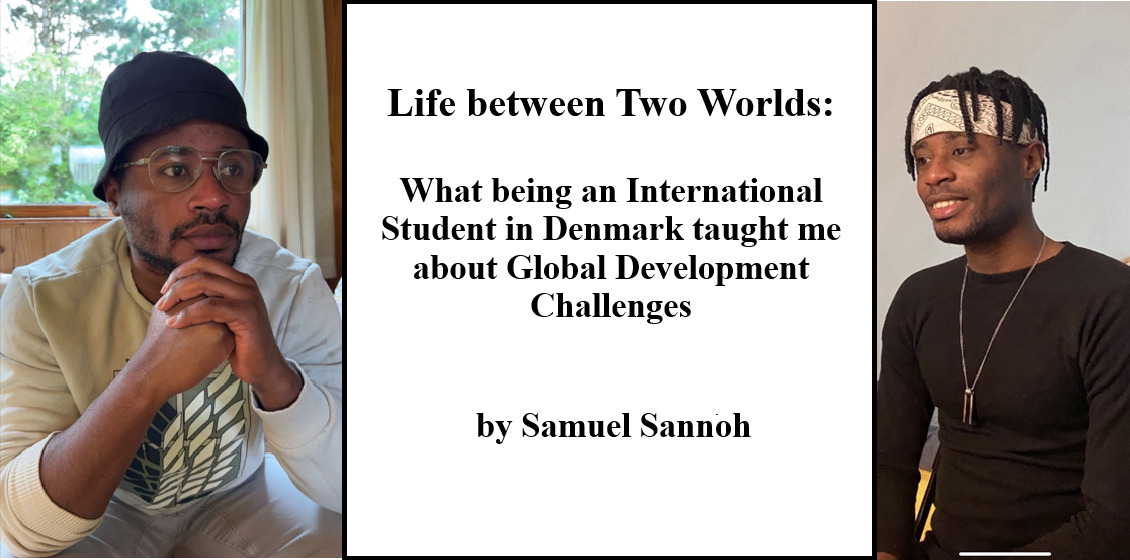
On the other hand, it can also be a burden. Living between two worlds, especially for someone as visible as me- recognisable with the bandana, the braids, the presence that has become part of my identity- comes with moments where I’ve felt the need to dim myself. There was a time when I stopped wearing the bandana just to “tone myself down” a bit, to make others more comfortable.
However, I realised I don’t have to shrink myself because ‘some’, not all, have created a mental image of who they think I am. I am not a threat to anyone-unless they choose to be one to me. Maybe that’s what “living between two worlds” really means: becoming more than a background character, turning our in-betweenness into contribution. If global challenges are truly shared challenges, then our lived experiences- our biases, our double perspectives, our ability to see more than one side- might be part of the solution. Changes rarely begin in institutions. It begins quietly, in how we as young people speak, listen, and create spaces where others- especially those who do not look like you or me- feel seen and heard.