 by
by How can a rich forest be protected from illegal logging, while safeguarding the communities who rely on it for survival? Two expert groups from Cambodia and Brazil share how memory, community knowledge and technology can shape sustainability and partnership amid the conflicting interests of resident communities and loggers.
Cambodia and Brazil are two different countries, yet their stories intersect at crucial points by the logging of their abundant forests and the presence of indigenous people living there. These forests are commonly being targeted by governments and private enterprises for commercial interests. It poses a significant threat to the environment and the livelihoods of resident indigenous people.
Prey Lang in Cambodia
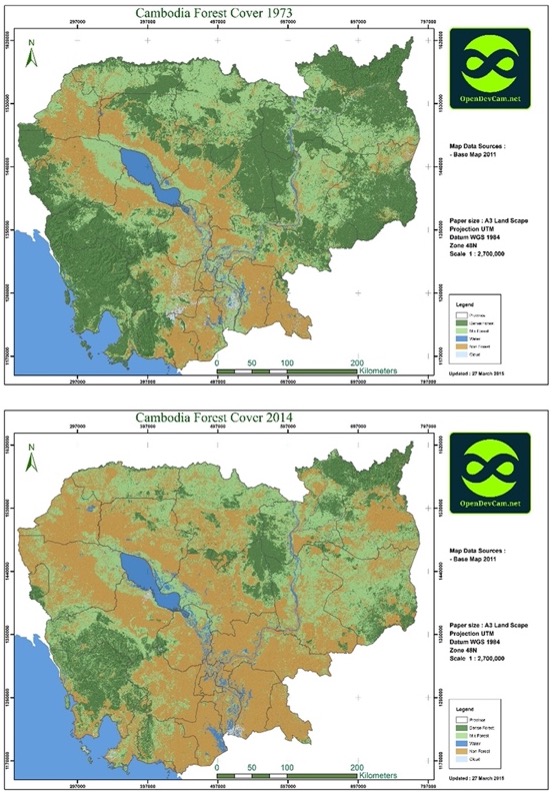
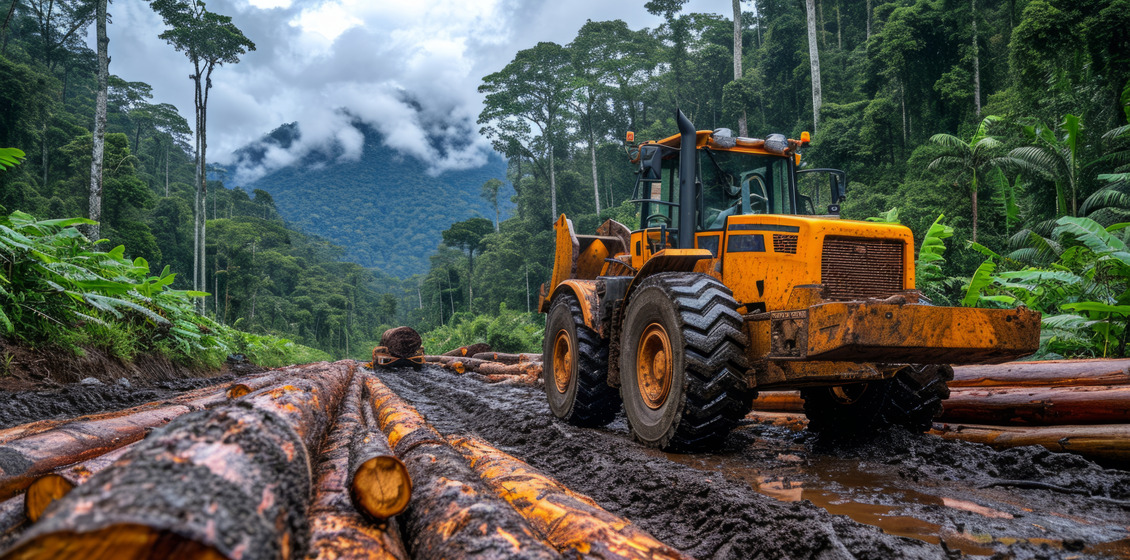
Cambodia set a world record for deforestation with which 1.5 percent of the country’s forests disappeared in 2021. Additionally, the country lost 31 percent of trees in protected areas since 2000, equivalent to 2.7 million hectares.
Prey Lang is the largest forest in Cambodia and the last remaining major lowland rainforest in the Southeast Asia. It is home to 250,000 indigenous Kuy people, 530 species of plants and animals. Protecting Prey Lang is vital not only for the ecosystem, but also for Kuy people who rely primarily on the land for survival, as well as 22 threatened species registered in the International Union for Conservation of Nature (IUCN)’s Red List.
Prey Lang has incrementally been the victim of illegal logging and deforestation due to its profitable luxury woods, agricultural potential for demanded plantations such as sugar, rubber and cassava, and presence of minerals such as timber. The forest is also aspired for further mining explorations for iron and gold. Considering the profits accrued by concession companies from Prey Lang, the environmental importance of the forest and livelihood of Kuy people has been systematically overshadowed.
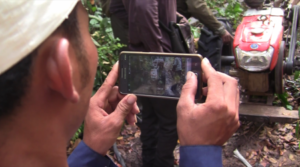
The Prey Lang Community Network (PLCN) took place to protect the forest from demolition with voluntary collaboration of indigenous community members. It mainly focuses on collection and dissemination of the information about illegal logging activities. PLCN has been utilizing smartphone technology with the Prey Lang App created in 2013 to collect data such as photographing and pinpointing the location of logging activities. The app also enables recording interactions with authorities, threats, and violence, as well as ascertaining climate-related figures.
The monitoring app is a geographic citizen science application that integrates with satellite GPAs and runs on smartphones. It was designed through a partnership between the University of Copenhagen (UCPH), PLCN, and local and international NGOs.
Besides restraining illegal logging in Prey Lang, the project team also induce advocacy by collection of data through the UCPH. They teach the Kuy people to use a social media platform, so that their reports can be the voice of them to draw public attention, like a citizen journalist.
Territories surrounding Trombetas River in Brazil
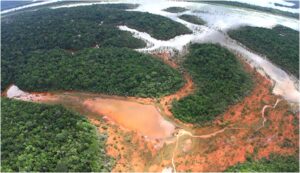
In this context, Brazil shares a similar pattern with Cambodia. Mining activities on the Trombetas River, mainly conducted by the fourth largest bauxite producer Mineração Rio do Norte (MRN), have adversely impacted the local quilombolas who face challenges in securing legal rights over the territories Alto Trombetas I and II. They have been neighbours of MRN and experienced firsthand the severe environmental effects of its operations for decades. The mining territories are federally conserved units by the government, which overlap with the territorial rights of quilombola communities.
The territorial conflict between quilombolas and conservation units for mining activities obstructs land titling. Furthermore, the continued distrust between the government and indigenous groups necessitates more time for the hearing process rather than for information and decision steps.
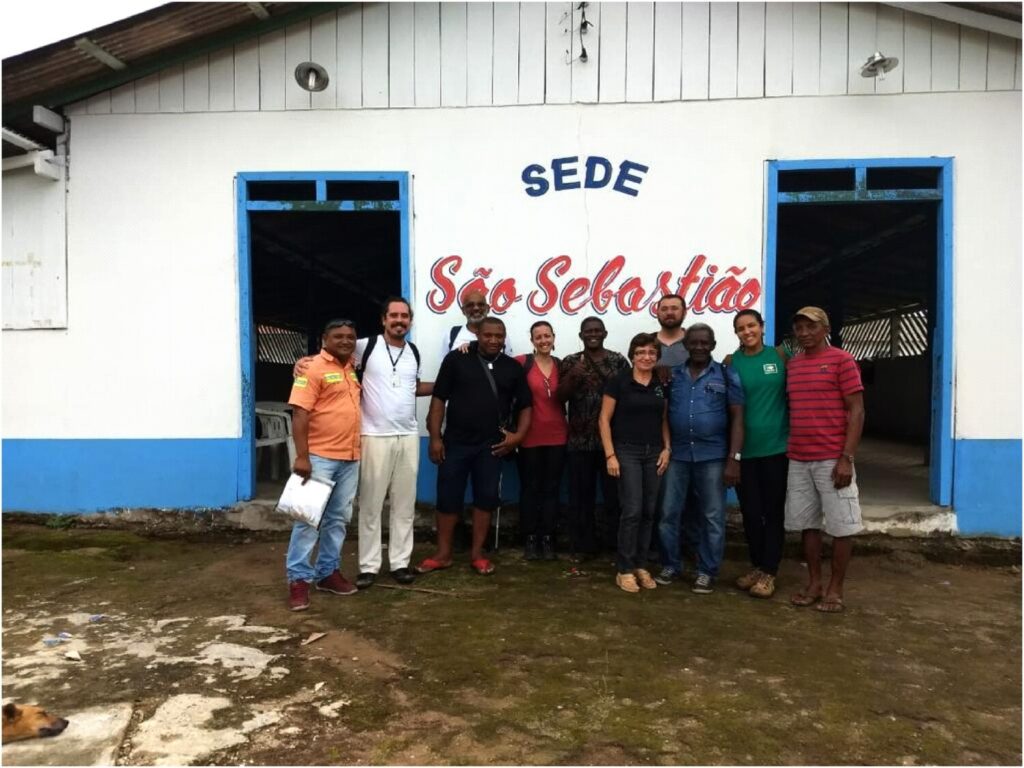
Julia Marques Dalla Costa, who served as deputy coordinator of the National Quilombola Environmental Licensing Team at The Instituto Nacional de Colonização e Reforma Agrária – INCRA (National Institute for Colonization and Agrarian Reform): “… it’s a process. We have to believe in the process, and we have to be very mindful with everything, every step on the way. So you became exceptional by time, you know, exempting yourself from the government or the image of the government they built over time by their traumas. Then you build the hearing again. By hearing, you try to understand. So you kind of became the common ground between them.”, she further explains how angry and frustrated quilombola people were initially.
“We are allies of the quilombolas because we are responsible for the titling of their lands. So they were like, you left us, you abandoned us. We were here for 10 years without any notice, without any resources.”, she adds what was crucial that worked for them to build the trust, through consistently being the same people that they can contact to, “we always try to keep with our word. So we have to be very cautious with what we are saying, what we are committing to”.
The indispensable pillars: collaboration and understanding
Community involvement is a highly effective strategy to cope with environmental issues. It is cost-effective, and capable of comprising a sustainable foundation for all parties involved. However, it requires multidimensional approach that incorporates social, institutional and economical aspects. When these aspects are absent, communities encounter problems that endanger their livelihoods and safety. Therefore, it is vital for both Kuy and Quilombola people that the education and peacebuilding process is handled in a multidimensional and sustainable way.
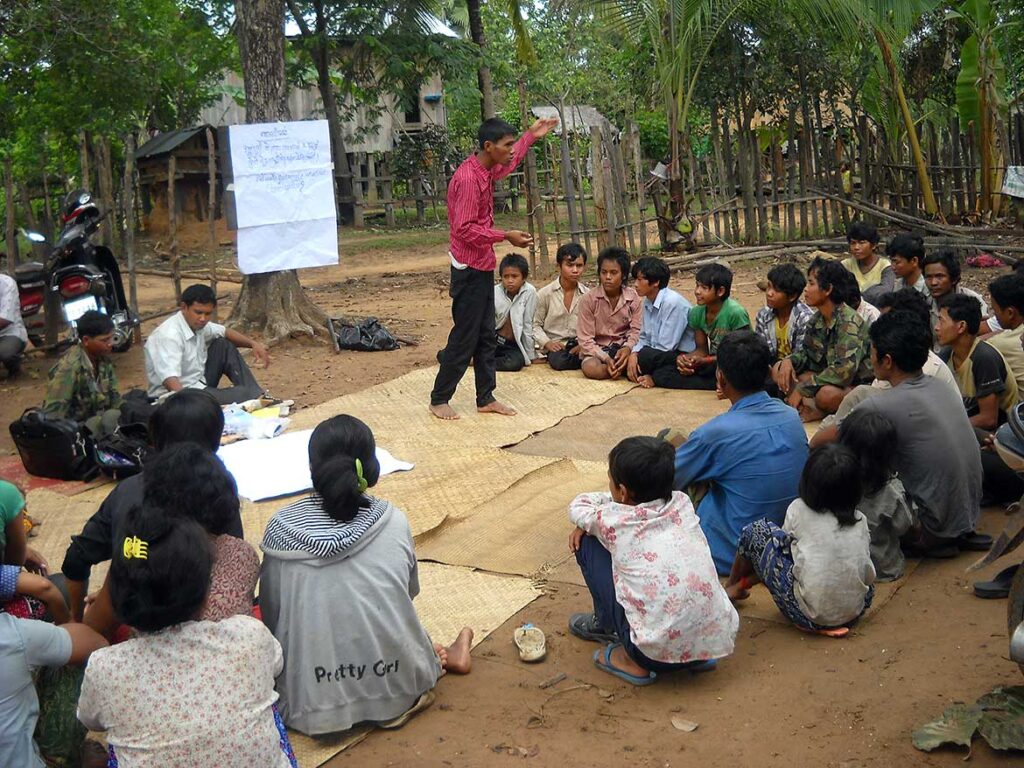
The project team in Prey Lang also facilitates peacebuilding between the community and the government through peace dialogues. They bring the communities into dialogue, both with local authority and moving forward with the national levels. They also held several forums that brought together key actors in this forest sector, including indigenous groups, NGOs, private sector representatives, and officials from the Ministry of Environment to present their priorities and the support they need. The forums were crucially important for relevant key actors to illustrate the issue and reach a common ground.
Integrating faith for biodiversity among the community was another step taken for sustainable peacebuilding and biodiversity protection. Forest is a sacred place for indigenous groups – a place for spiritual practices. Additionally, collaborating with monks and other religious leaders to hold tree ordination and tree planting eased the process for Prey Lang. “Religious leaders hold moral authority, and they are able to mobilize communities for tree planting. For example, if we have reforestations initiatives, they mobilize the community and engage with authority. Authorities are more collaborative when it comes to religious leaders so that they join the efforts. And this kind of initiative also creates more understanding and trust between the communities and authorities.” the project team member explains.
“We hope that at the end of the day, the communities, the states and those who work in the forest sector can understand each other and collaborate to protect the forest.” the team member says.
Indigenous People and Local Communities (LCIPs) hold deep ecological knowledge, and they have great wisdom in forest protection, with a long-standing tradition of passing on their knowledge from one generation to the next. For this reason, it is extremely helpful for researchers and states to integrate the science knowledge with traditional knowledge and recognise the crucial role of LCIPs in forest and biodiversity conservation.
Julia refers to Bronislaw Malinowski’s pioneering quota to approach this particular issue: “We should have the native point of view… it’s very basic but important and core lesson in anthropology that you have to connect to understand why that person or group having that position is making those statements, what is their point of view towards that problem, that institution or someone.”
“A first step for them to trust you. Imposing your own information on them, look, you feel in this way, you need this… As an outsider, you just need to bring their own knowledge, own experiences, values and feelings. Combine and prioritize their own experiences over your solutions.” Julia concludes.
Malinowski’s theory claiming to “grasp the native’s point of view, his relation to life, to realize his vision of his world” sheds light on the path to partnership with local communities in response to the damage caused by mining companies in Prey Lang and the territories surrounding the Trombetas River over the years. It is therefore vital to empower local people, not only for their fundamental rights, but also to facilitate collaborative efforts to preserve the biodiverse landscapes that are home to hundreds of species.
Nilüfer Khudaykulov is a MSc student in International Politics and Governance at Roskilde University and a DDRN intern