 by
by When democracy is invoked as a global ideal, its symbolic origins are often traced to Ancient Greece, a historical reference point for political equality and civic participation respecting the rule of law. In modern governance discourse these principles are embedded in constitutions and legal systems across the world. Yet the persistence of corruption and weak enforcement raises a critical question: to what extent do democratic systems deliver on their promises in practice?
Recent developments in Greece offer a compelling entry point into this question. Rather than treating Greece as an outlier, this article positions it as a mirror reflecting broader structural tensions between formal democratic compliance and substantive governance outcomes across both high income and developing contexts.
The Compliance Illusion in Democratic Systems
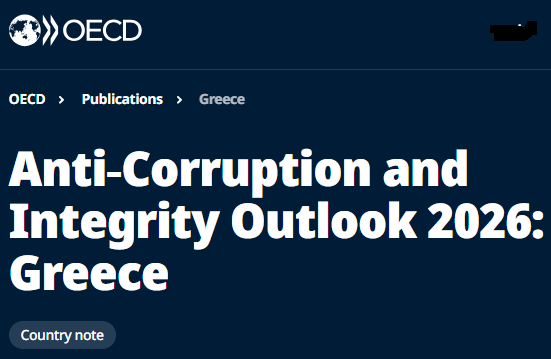
Contemporary governance assessments often prioritize institutional design: the presence of courts, regulatory bodies, anti-corruption agencies, and electoral mechanisms. By these metrics, Greece appears institutionally robust. As a member of the European Union, it operates within a dense framework of legal obligations, oversight mechanisms, and policy coordination.
However, the Greek case highlights what can be described as a compliance illusion: the coexistence of formal adherence to democratic norms with persistent deficiencies in enforcement and accountability. Laws exist, but their application is uneven. Oversight bodies are established, but their effectiveness is constrained. Judicial processes function but often at a pace or in a manner that undermines public trust. This distinction between de jure and de facto governance is well established in development research, yet Greece underscores how it remains insufficiently addressed even within consolidated democracies.
Crisis as a Lens: Institutional Failure Made Visible
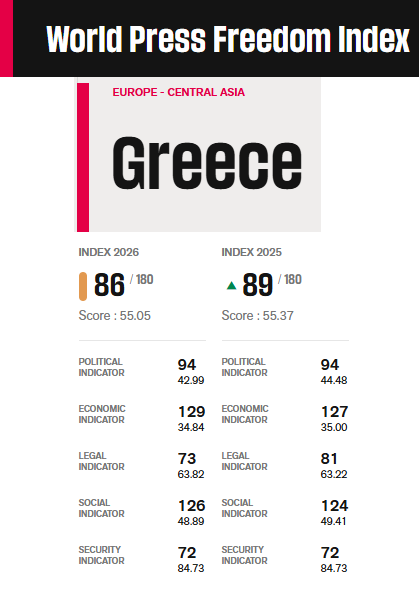
A series of high-profile events in Greece has recently brought structural weaknesses in governance and accountability into sharper focus, particularly in relation to infrastructure safety, rule of law and press freedom.
One of the most consequential cases is the Tempi train disaster (28 February 2023), in which a passenger train and a freight train collided near Tempi in central Greece, resulting in the deaths of 57 people. The incident exposed long-standing deficiencies in Hellenic Train operations, OSE (Hellenic Railways Organization) infrastructure management, and the delayed implementation of the European Rail Traffic Management System (ERTMS). Subsequent investigations and parliamentary debates revealed systemic issues including under staffing, chronic under investment and fragmented responsibility between national authorities and private operators.
Public reactions to the disaster, widely documented across Greek and international media, including reporting by Kathimerini, To Vima, and BBC News, framed the event not as an accident in isolation but as the culmination of institutional neglect. Large scale protests in Athens and Thessaloniki reflected a broader perception that regulatory failure, rather than individual error, lay at the core of the tragedy.
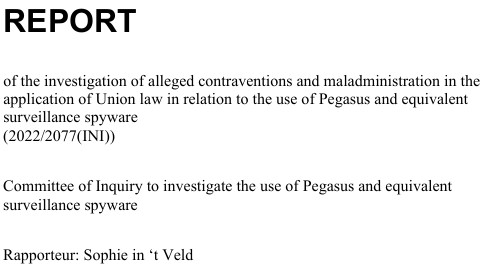
The second major case is the Predator spyware scandal (2022–2023), involving allegations that government-linked actors used commercial spyware to surveil journalists, opposition politicians, and public officials. Investigations by outlets such as Inside Story, Reporters United, and Forensic Architecture collaborators in Greece, alongside reporting by The New York Times and Politico Europe, linked the use of Predator software to attempts to monitor communications of individuals including journalist Thanasis Koukakis and political figures such as Nikos Androulakis, leader of PASOK-KINAL and Member of the European Parliament.
The scandal also coincided with revelations that the National Intelligence Service (EYP) had legally surveilled journalists, prompting concerns about the effectiveness of institutional safeguards and parliamentary oversight. Journalists such as Stelios Kouloglou along with investigative teams at Reporters United, emphasized the broader implications of these practices for press freedom, transparency and democratic accountability.
Taken together, these cases are significant not only because of their immediate human and political impact but because of what followed: prolonged judicial processes, fragmented investigative outcomes and competing narratives between state institutions, opposition parties and independent media.
From a governance perspective, both the Tempi disaster and the Predator scandal reveal a recurring pattern: institutional failure is not always experienced as a sudden breakdown but as a gradual erosion of trust in regulatory capacity. Public discourse increasingly reflects the perception that the central issue is not the absence of formal rules but the absence of credible enforcement mechanisms and independent oversight.
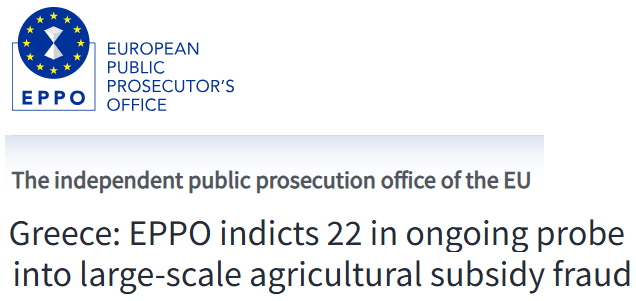
Beyond these cases, Greece has also come under increased scrutiny at the European level through the work of the European Public Prosecutor’s Office (EPPO), led by Laura Codruța Kövesi. The EPPO has opened multiple investigations into alleged misuse of EU funds and financial irregularities, particularly in relation to agricultural subsidies and procurement systems. These investigations have sparked significant political debate within Greece and raised broader questions about the effectiveness of national oversight mechanisms in ensuring compliance with EU financial and rule-of-law standards.
Kövesi’s role is particularly significant because the EPPO represents one of the strongest supranational enforcement mechanisms within the European Union, with the mandate to investigate and prosecute crimes affecting the EU budget. In this context, the Greek cases under review have contributed to wider discussions about institutional accountability, administrative transparency and the capacity of national systems to effectively prevent and address financial misconduct.
Trust, Justice, and the Limits of Legalism
The erosion of trust in public institutions is a central consequence of this gap. Greece has long maintained a strong legal culture, with widespread recourse to judicial mechanisms. Yet increasing delays in court proceedings and perceptions of unequal treatment have weakened confidence in the justice system.
The result is a shift from reliance on formal institutions to a more ambivalent stance, in which legality is not necessarily equated with fairness. This reflects a broader challenge: when legal systems are perceived as inaccessible, slow, or biased, their legitimacy diminishes even if their formal structure remains intact.
Such dynamics are not unique to Greece. Across multiple contexts, trust in institutions has emerged as a key variable shaping governance outcomes, influencing everything from tax compliance to public service delivery.
From National Case to Global Pattern
Interpreting Greece as a mirror rather than an exception reveals important parallels with other regions. In parts of France and Serbia, concerns have similarly been raised regarding political influence over judicial processes and the uneven application of accountability mechanisms. These cases challenge the assumption that strong institutional frameworks automatically produce effective governance.
More strikingly, comparable dynamics are evident across many countries in Sub-Saharan Africa. Over the past decades, significant efforts—often supported by international donors—have been made to strengthen legal systems, enhance transparency and combat corruption. While these reforms have led to measurable improvements in some areas, their impact has frequently been constrained by limited enforcement capacity and entrenched political interests.
This suggests that the gap between formal institutions and practical outcomes is not a function of geography or income level, but of deeper structural factors.
The Political Economy of Enforcement
To understand why such gaps persist it is necessary to move beyond institutional design and consider political economy dynamics. Enforcement is not merely a technical process. It is inherently political. Where elites benefit from selective application of rules, there may be limited incentives to strengthen accountability mechanisms. In such contexts, institutions can serve dual purposes: signaling compliance to external actors while preserving flexibility internally.
This duality helps explain why reforms—whether driven by European integration processes or international development agendas—may result in institutional convergence without corresponding improvements in practice. The adoption of laws and frameworks can be relatively rapid while transforming enforcement cultures and power relations is considerably more complex.
Implications for Development Research and Policy
For the broader development community, the Greek case offers several key insights. First, it challenges the implicit dichotomy between “developed” and “developing” governance systems. The presence of institutional gaps within an EU member state underscores that governance challenges are not confined to the Global South. Second, it highlights the limitations of reform strategies focused primarily on institutional form. Legal transplants, anti-corruption frameworks, and oversight bodies are necessary components of governance but their effectiveness depends on enforcement, independence, and political support. Third, it reinforces the importance of accountability ecosystems. Civil society, investigative journalism, and supranational institutions can play critical roles in exposing and addressing governance failures. However their capacity to do so varies significantly across contexts and may itself be contested.
Rethinking Democracy Beyond Form
At a conceptual level, the persistence of the compliance illusion invites a reassessment of how democracy is evaluated. Traditional metrics such as the existence of elections or formal institutional structures capture important dimensions, but may overlook the quality of governance in practice.
This aligns with broader debates in political theory dating back to Plato, regarding the relationship between ideals and reality. While democratic systems are grounded in normative principles of equality and justice, their legitimacy ultimately depends on their ability to deliver tangible outcomes. If citizens perceive that laws are selectively applied or that accountability is inconsistent, the credibility of democratic institutions may erode even in formally stable systems.
Conclusion: From Greece to the World
Greece’s recent experience does not represent a failure of democracy per se, but rather a manifestation of a broader and more persistent challenge: aligning institutional form with institutional function. By viewing Greece as a mirror, we gain a clearer understanding of similar dynamics across diverse contexts, including those traditionally categorized within the Global South. The lesson for development research is not that democratic models are flawed, but that their implementation requires sustained attention to enforcement, incentives, and power structures.
Bridging the gap between theory and practice is not simply a legal or technical task, it is a political and societal one. Until this gap is addressed the risk remains that democracy will continue to function convincingly on paper, while falling short in practice.
Maria Zapri is a Law student with Aristotle University of Thessaloniki, Greece, and a DDRN INTERN.